Overview 项目概述
This project showcases how I designed and delivered an end-to-end digital solution across IoT devices, station-level optimization, and service operations, helping industrial customers shift from reactive maintenance to predictable, measurable customer success.
By integrating three platforms — Air Compressor IoT Platform, Smart Air Station SaaS, and Hui Service CRM — I enabled OEMs and service partners to improve operational efficiency, prove energy-saving value, and build scalable service-based revenue models.
本项目展示了我如何通过体验与解决方案设计,打通设备层、站房层与服务层,帮助工业客户从“被动维修”转型为可预测、可量化的客户成功模式。
通过整合空压机物联网平台、智能空压站 SaaS 与汇服务 CRM,支持 OEM 与服务商提升运营效率、验证节能价值,并构建可规模化的服务型收入模式。

Project Background 项目背景
From Product Delivery to Customer Achievement
从“交付产品” → “成就客户”
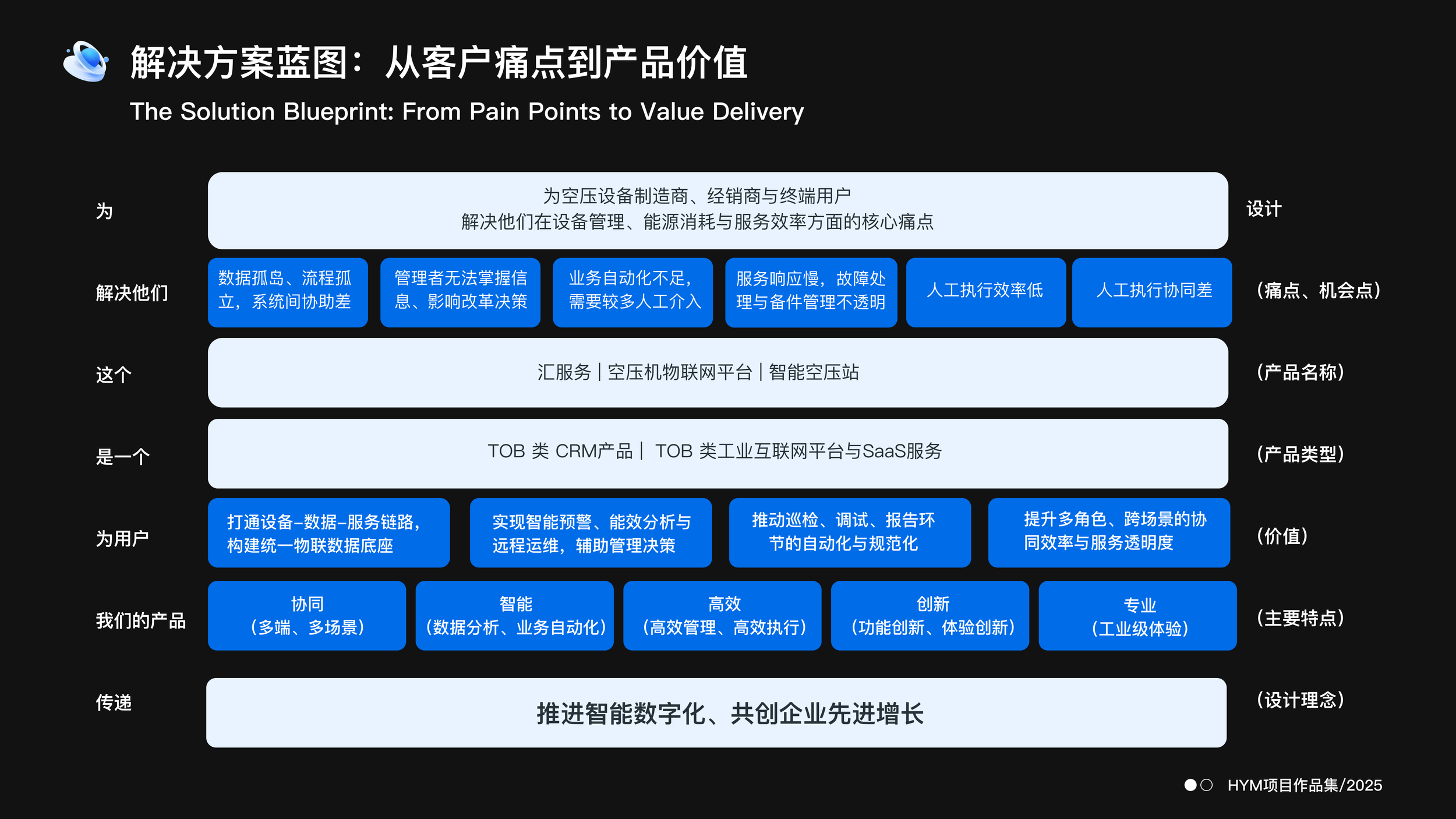
This project focuses on OEM manufacturers who are transitioning from a product-driven model to a service-driven business.
To support this transformation, the company adopted three separate SaaS systems, each designed for a different business scenario: equipment management, energy optimization, and after-sales service.
However, in practice, these systems operated independently, resulting in fragmented service capabilities.
The challenges can be understood across three layers:
1. Equipment Layer (IoT Platform)
After delivery, equipment lacks continuous connectivity and visibility. OEMs cannot monitor real-time status or failures, leading to reactive service. In addition, the lack of usage data limits product improvement and value-added service design.
2. Station Layer (Energy Optimization SaaS)
Multi-device coordination is inefficient, and energy management relies heavily on manual processes. Data is fragmented and not continuous, making it difficult to quantify energy-saving outcomes and support business decisions.
3. Service Layer (CRM SaaS)
After-sales workflows depend heavily on manual coordination. Ticketing and spare parts management lack transparency and efficiency. Service channels are fragmented, and basic inquiries consume significant resources. Most importantly, service value cannot be clearly measured.
It is important to note that these three SaaS systems are independent in terms of business functions and use cases.
Each serves a different purpose: equipment monitoring, energy optimization, and service management.
However, they target the same customer group—OEMs and their downstream distributors and end users—and collectively support the transformation from product sales to service-driven business.
Against this background, the core question of this project is:
how to, from a user and service perspective, connect key data and business touchpoints across independent systems, and enable service to evolve from a cost center into a measurable and scalable profit driver.
I worked as the Experience Lead, responsible for defining and driving the market insight framework for this project.
本项目面向装备制造企业(OEM),其核心业务正从“卖设备”向“卖服务”转型。在这一过程中,OEM分别引入了三套面向不同业务场景的SaaS产品,用于支撑设备管理、站房节能与售后服务体系。但在实际使用中,不同业务环节各自割裂,导致整体服务能力难以发挥。
具体体现在三个层面:
1. 设备层(空压机物联网平台)
设备售出后缺乏持续连接与监控,OEM无法掌握设备运行状态与故障情况,售后响应被动;同时缺乏设备使用数据,难以支持产品迭代与增值服务设计。
2. 站房层(智能空压站SaaS)
多设备协同效率低,能耗管理依赖人工经验,数据分散且不连续;节能改造缺乏量化依据,难以支撑业务决策与客户转化。
3. 服务层(汇服务CRM SaaS)
售后服务流程高度依赖人工与线下协同,工单流转效率低;备件管理不透明;服务入口分散,资源被基础咨询占用;同时服务价值缺乏量化手段,难以支撑续保与复购。
需要强调的是,这三套SaaS产品在业务上相互独立,分别服务于不同的使用场景与角色:
物联网平台用于设备管理,智能空压站用于节能优化,CRM用于售后服务体系管理。
但它们面向的是同一类客户群体(OEM及其下游经销商与终端用户),共同服务于企业从“卖设备”向“卖服务”的转型目标。
在该背景下,本项目的核心问题是:
如何在多系统独立存在的前提下,从用户与服务视角出发,打通关键数据与业务链路,使“服务”从成本中心转变为可管理、可量化的利润中心。
我在项目中担任体验负责人,主导了整体市场洞察框架的发起与落地。
Solution Overview (End-to-End Value Loop)
解决方案概述:端到端价值闭环
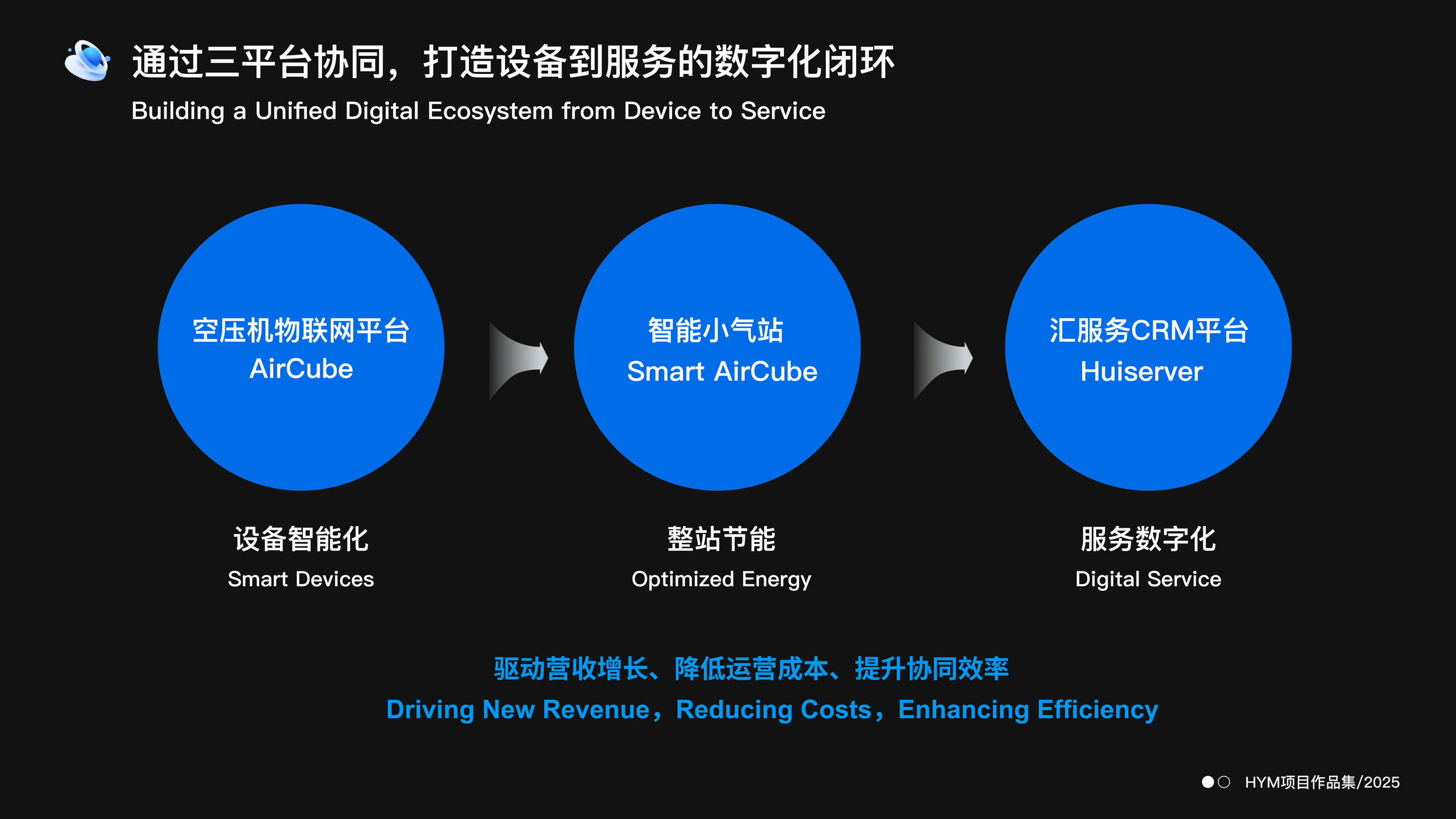
The solution consists of three interconnected platforms, forming a complete value loop across the customer lifecycle. I designed the overall approach as an End-to-End Value Loop, ensuring that customer value is continuously created, validated, and amplified over time.
End-to-End Value Loop
Device Connectivity
Devices are connected through the IoT platform, enabling real-time data acquisition.Station-Level Optimization
System-level energy optimization and intelligent control are implemented at the air station level.Service Execution
Service delivery and operations are managed through the CRM platform.Value Validation
Outcomes are visualized and quantified, making value transparent and credible.Scalable Growth
Proven results support renewals, upsell opportunities, and customer expansion.
Through this closed-loop approach, operational data is transformed into customer trust, measurable business value, and long-term retention.
该方案由三个平台构成,形成完整的价值闭环。我将整体方案设计为一个端到端价值闭环,确保客户价值在整个生命周期中被持续创造、验证和放大。
价值闭环路径:
设备上云:通过 IoT 平台完成设备接入
整站优化:在空压站层面实现系统级节能与控制
服务执行:通过 CRM 平台完成服务交付与管理
价值验证:将结果可视化、可量化
规模复制:支持续费、增购与客户扩展
该闭环将数据转化为信任、商业价值与客户长期留存。
My Role & Key Responsibilities 角色职责
Service Experience Designer(Interaction & Research)
My Responsibilities Included:
Leading customer research across operators, OEM managers, and service teams
Translating customer success goals into product and service strategies
Designing cross-platform workflows and experience architecture
Defining measurable success metrics
Supporting commercialization through value storytelling and metrics
I was not only designing solutions — I was responsible for making them successful in real customer environments.
体验设计师(交互设计 & 用户研究)
我的核心职责包括:
主导多角色用户调研(终端用户 / OEM管理者 / 服务团队)
将客户成功目标转化为产品与服务策略
设计跨平台体验架构与关键业务流程
定义可量化的成功指标(三个平台三套指标)
支持商业化落地与价值表达
不仅设计方案,更对方案在真实客户场景中的成功负责。
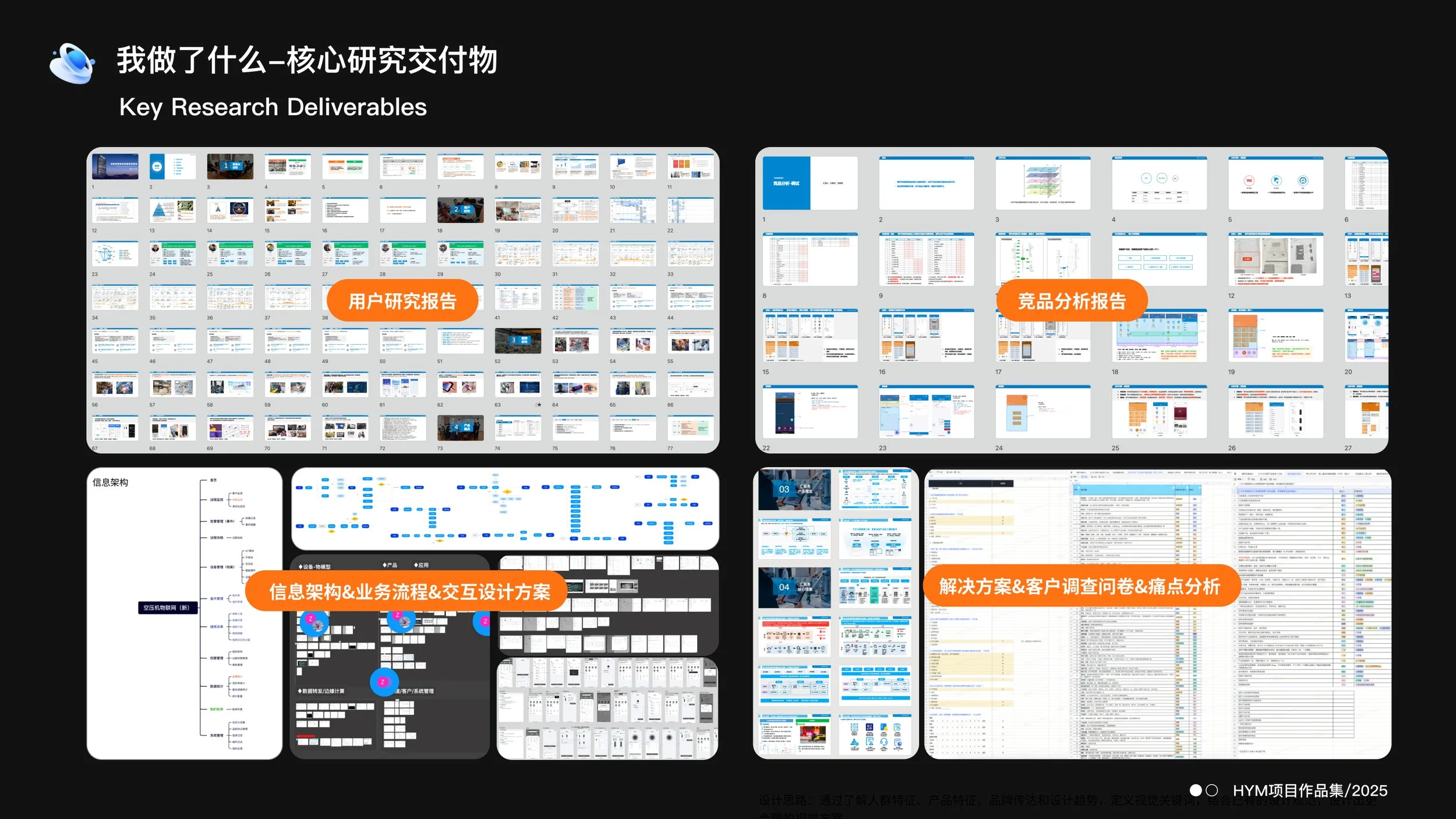
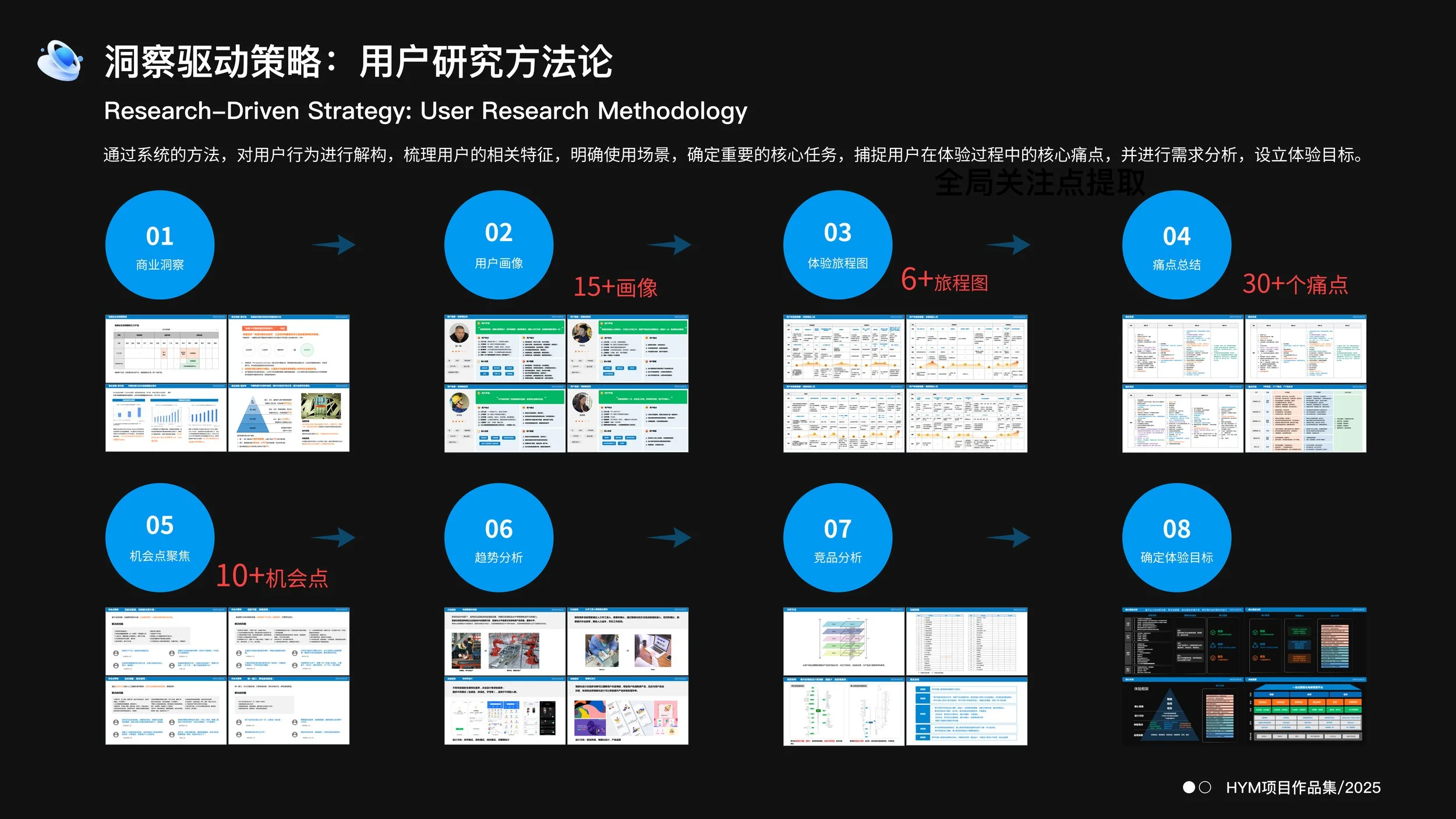
以体验设计负责人的身份,主导了一套完整的用户研究方法论落地:从商业洞察、用户画像(15 + 画像)、体验旅程图(6 + 旅程图)、痛点总结(30 + 痛点),到机会点聚焦(10 + 机会点)、趋势分析、竞品分析,最终输出可量化的体验目标;同时交付了用户研究报告、竞品分析报告、信息架构 & 业务流程 & PRD&交互设计方案、解决方案等核心成果,为解决方案提供了数据驱动的全链路支撑。
Customer Success-Driven Need Discovery & Validation
客户成功导向的需求洞察与验证方法
Multi-Dimensional Customer Insight Framework
多维度客户洞察框架
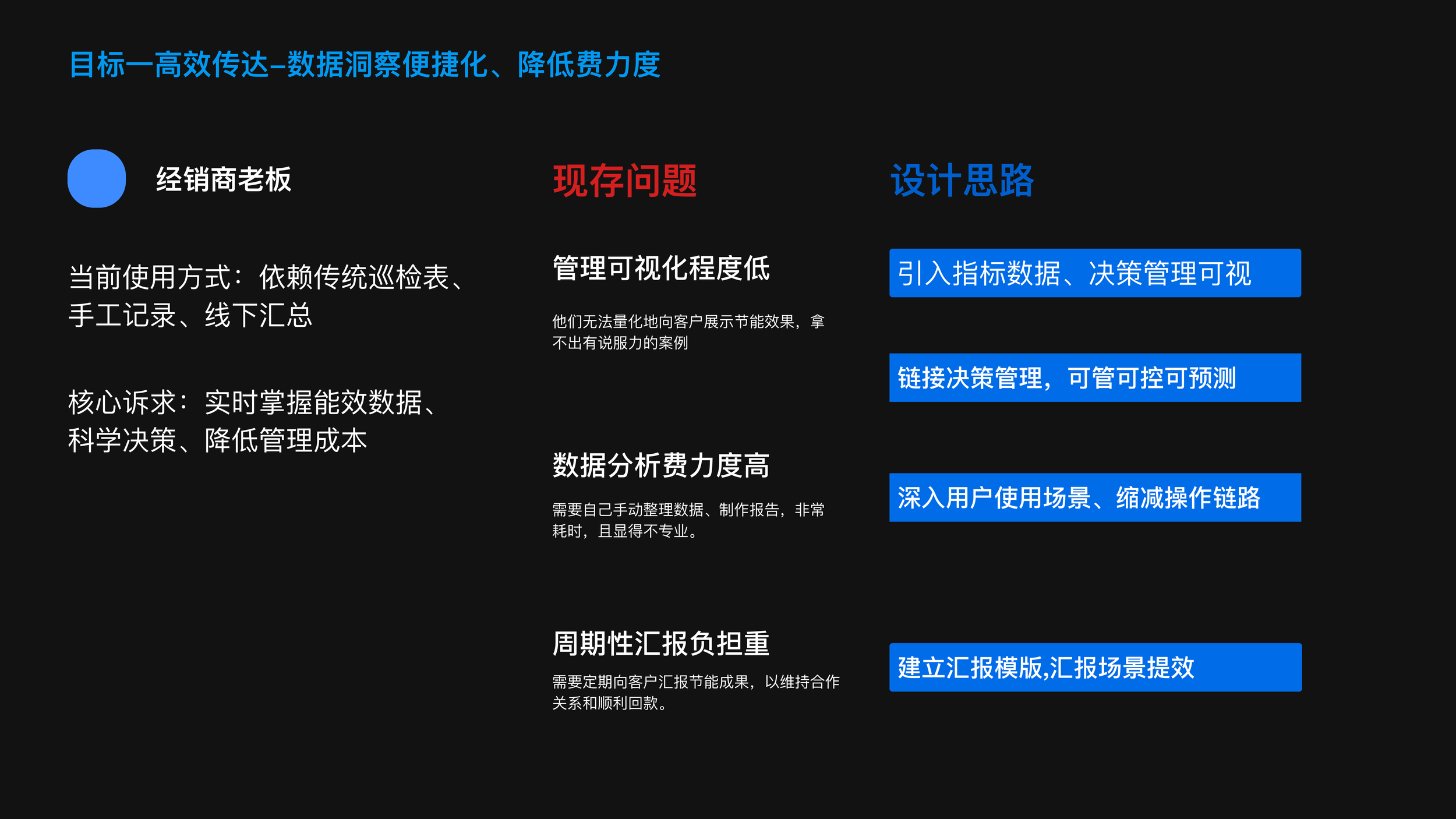
I adopted a five-layer analysis model: business scenario → user role → key task → pain point → success indicator. This ensured that design always serves the customer’s business objectives.
I validated the needs through:
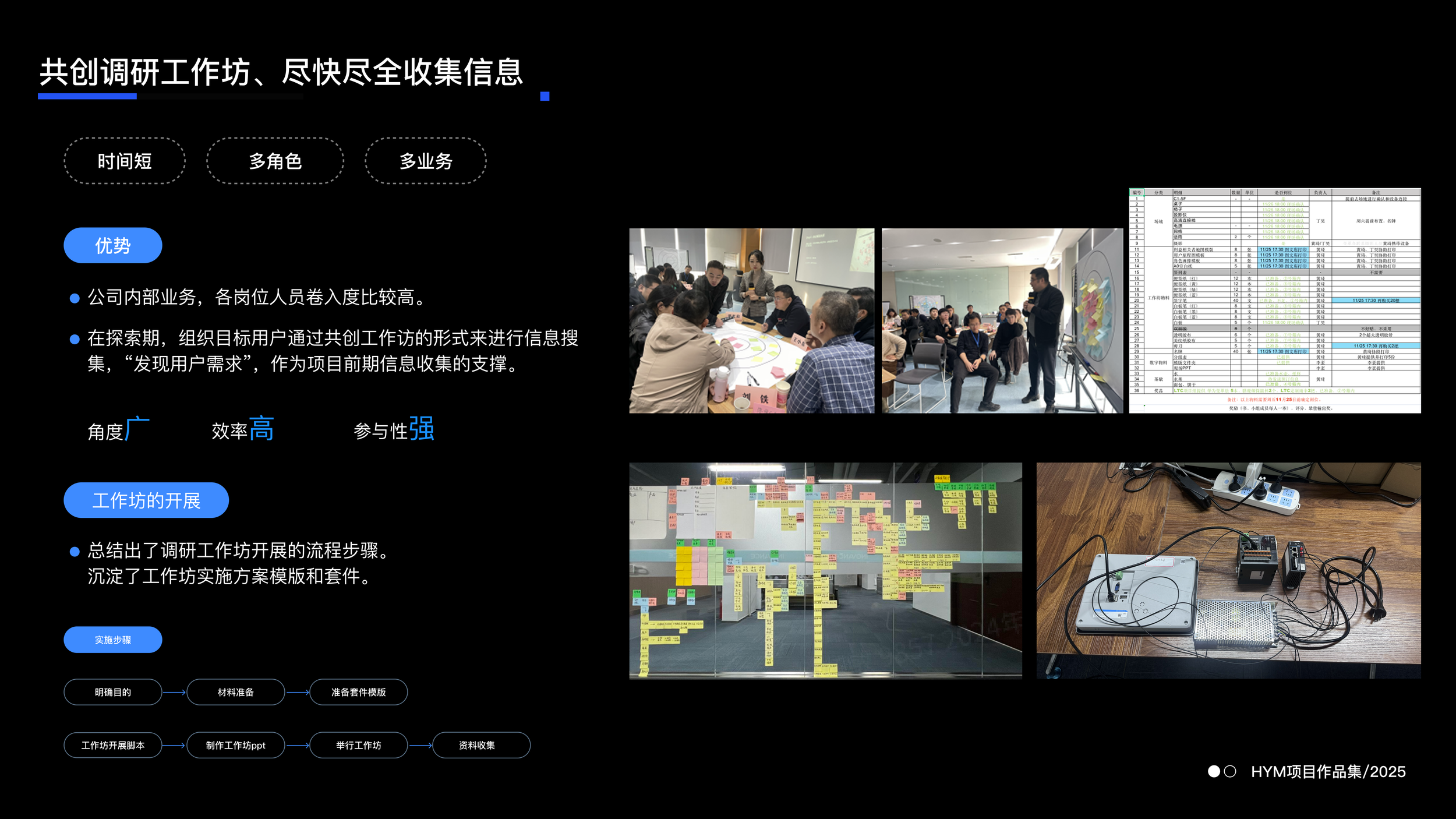
Workshops with customers, sales, and service teams to define “success scenarios.”
Quantitative Pain Point Analysis: Narrowing down 30+ pain points to 8 core issues.
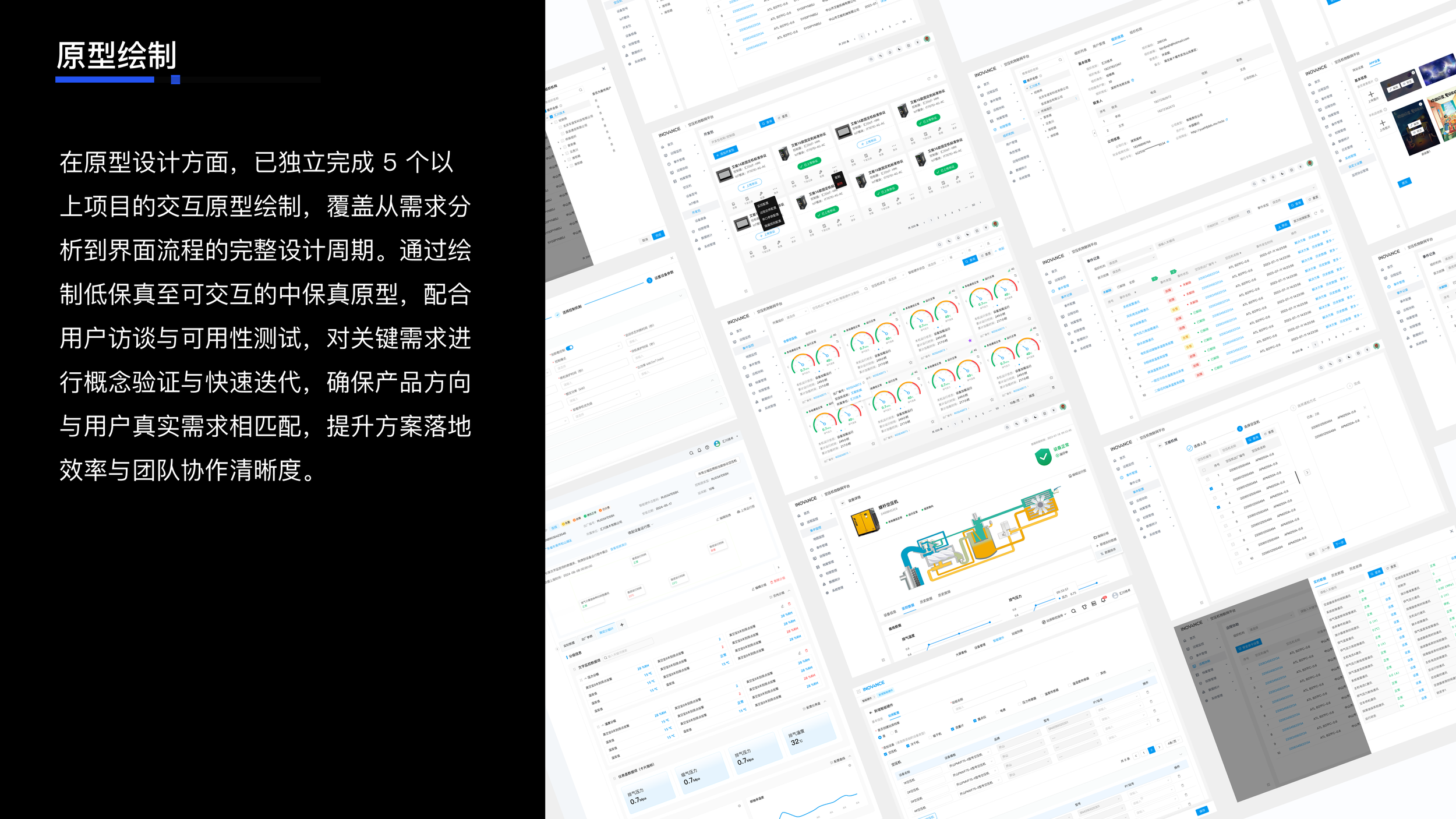
Prototype Testing & Data Simulation: Validating solution feasibility with interactive prototypes and historical data.
Kano Model Analysis: Categorizing features into Must-be, Performance, and Delighter needs to prioritize the roadmap.
摒弃传统的功能清单式需求收集,我转而采用业务场景→用户角色→关键任务→痛点→成功指标的五层分析模型,确保设计始终服务于客户业务目标。
我通过以下方法系统验证需求真实性、优先级与价值潜力:
工作坊共创:与客户、销售、服务团队共同定义“成功场景”
痛点量化分析:30+痛点中聚焦8个高影响、高频率的核心问题
原型测试 + 数据模拟:用可交互原型验证方案可行性,并用历史数据模拟价值效果
Kano模型分析:区分基本型、期望型与魅力型需求,规划体验演进路径
Platform 01: Smart Air Station Solution
平台01:智能空压站解决方案
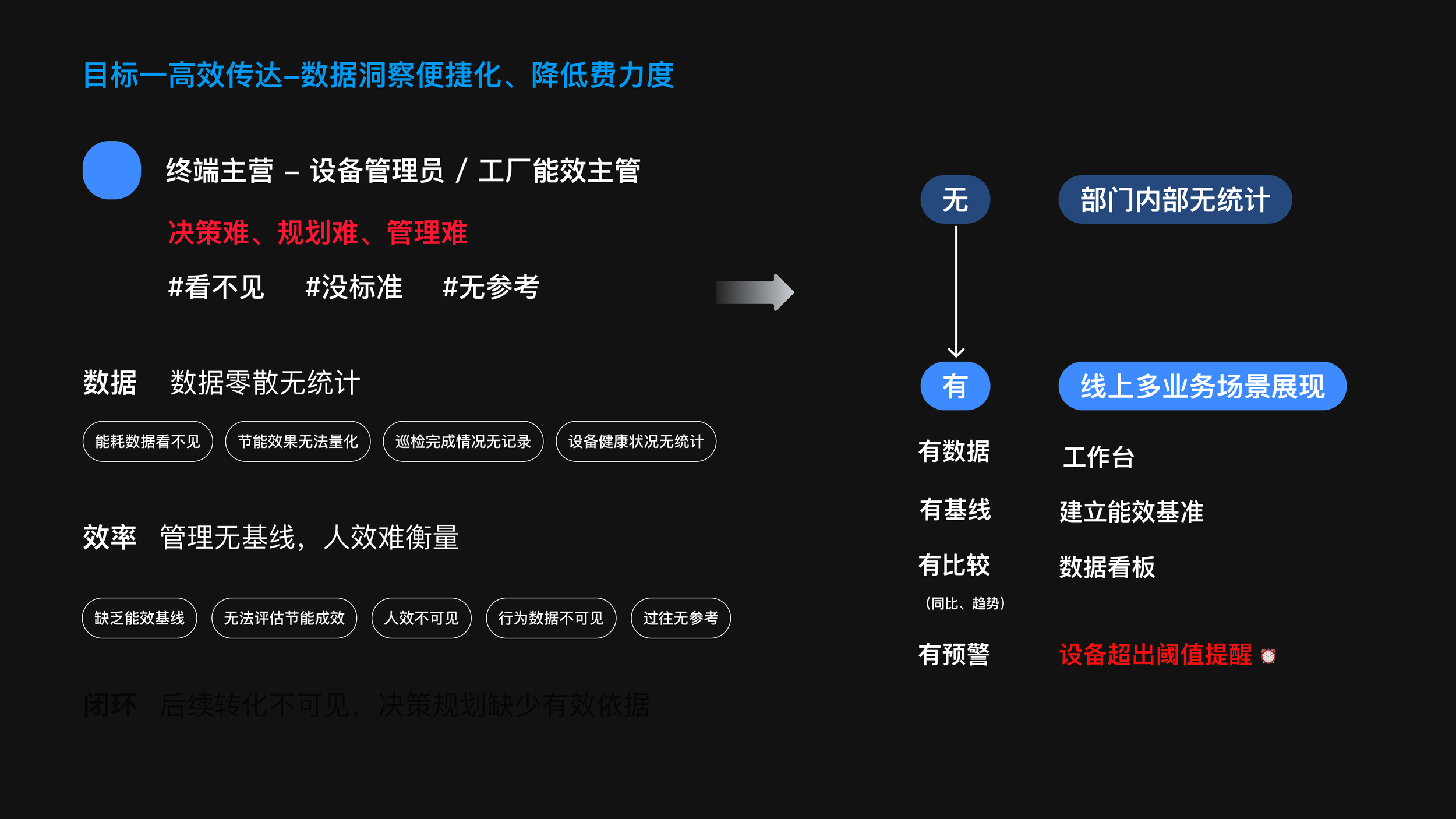
Turning Energy Optimization into Provable Customer Value
整站节能 = 客户“看得见的价值”
The Smart Air Station SaaS focuses on system-level outcomes, helping customers move from fragmented device operations to measurable energy and cost performance.
As the service and experience design lead, I played a key role in translating complex operational data into clear, decision-ready value narratives for both customers and dealers.
智能空压站 SaaS 聚焦于系统级成果,帮助客户从割裂的设备管理模式,升级为可量化、可验证的节能与成本优化结果。作为客户体验负责人,我重点参与了将复杂的运行数据转化为管理层与业务方都能理解和信任的价值表达方式,识别客户成功痛点。
Solution 解决方案
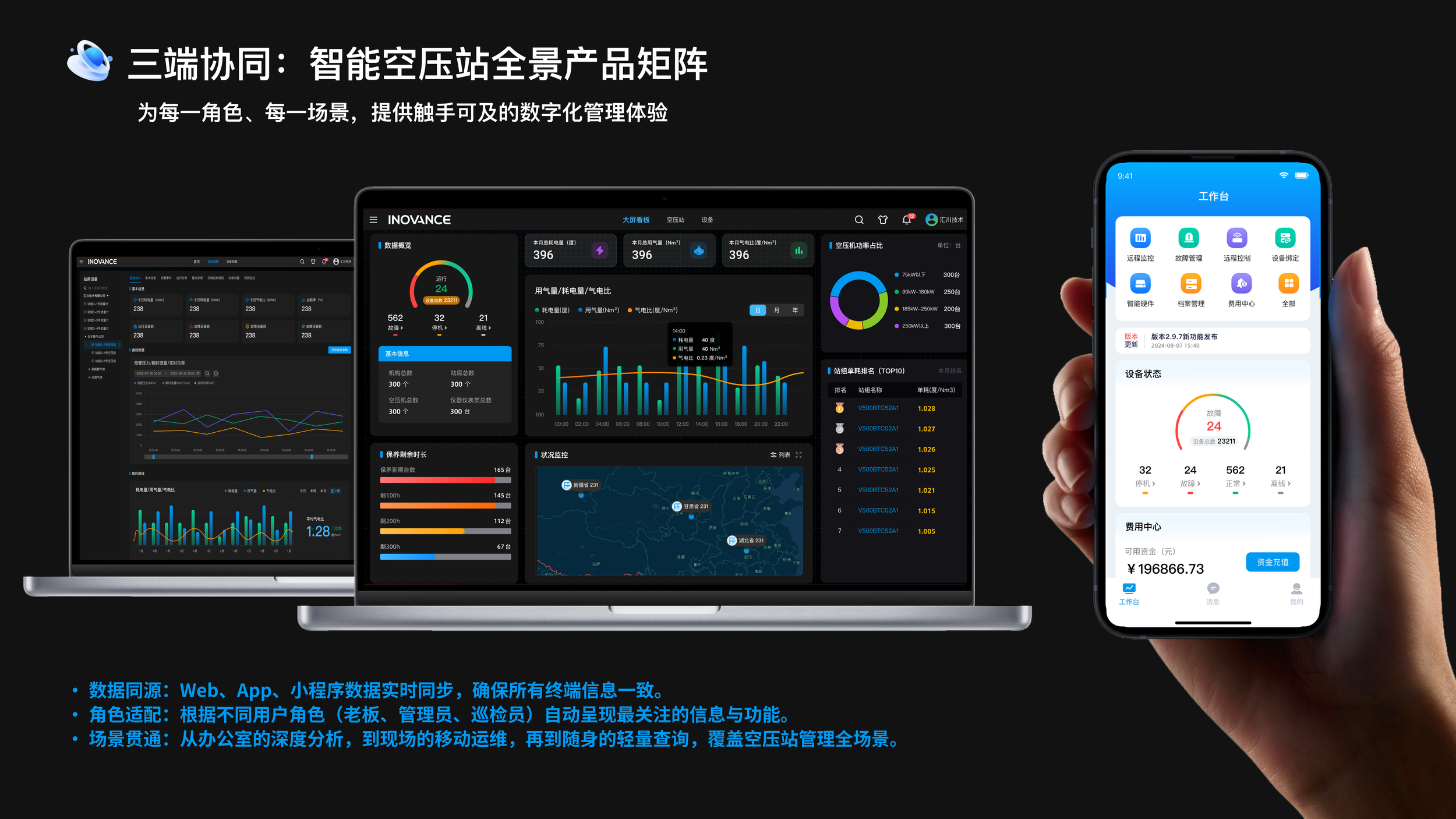
From an experience and service design perspective, I ensured that energy-saving value is perceivable, verifiable, and reusable:
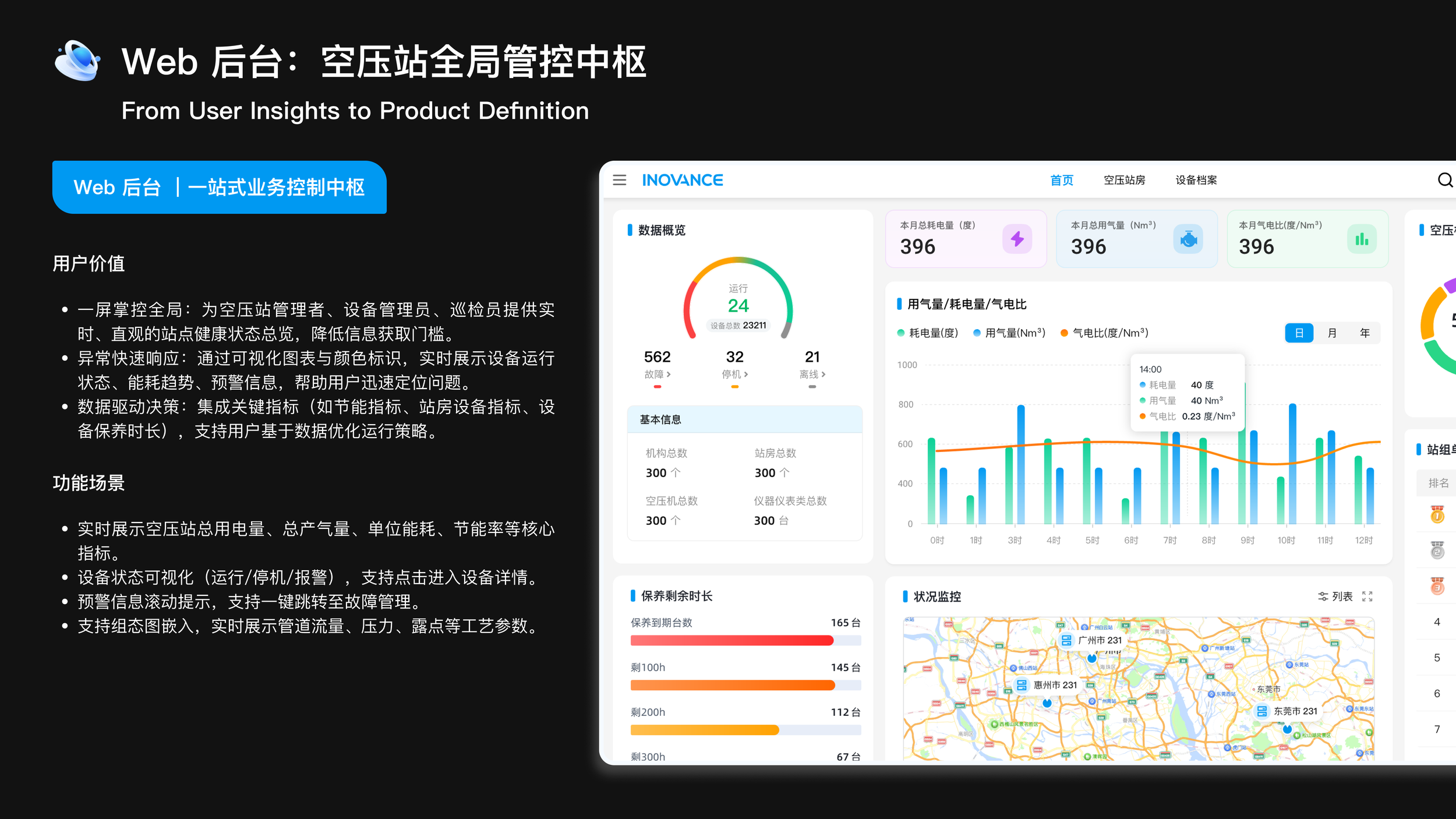
Centralized Web Control Dashboard
Designed a unified view of energy consumption, system health, and alerts to support daily operations, maintenance workflows, and management decision-making.
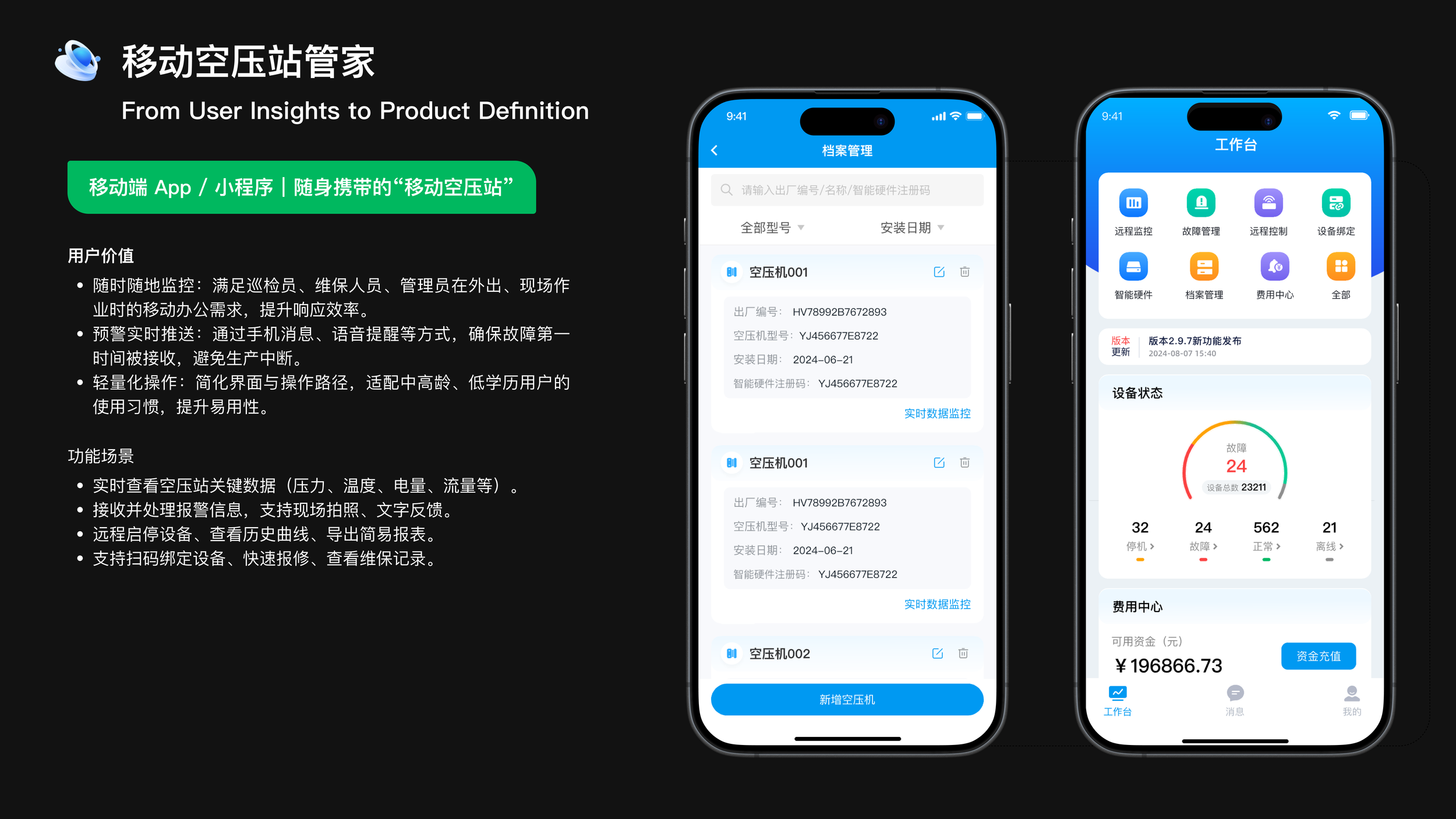
Mobile Experience Delivery
Streamlined user journeys for multi-role mobile scenarios, enabling real-time data access, alarm handling, and remote start/stop operations to support convenient off-site and on-site management.
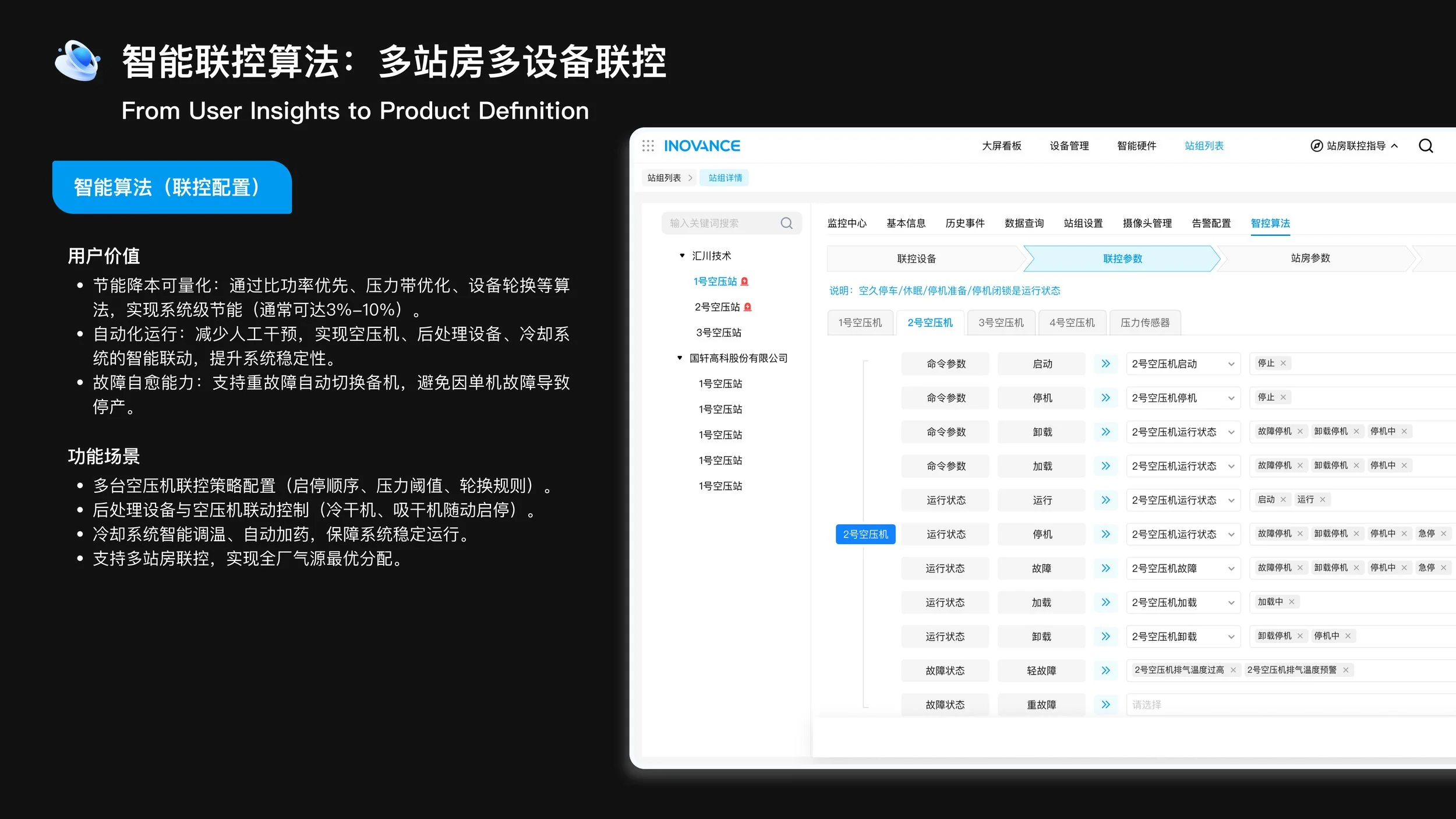
Experience Translation of Group Control Algorithms
Worked closely with algorithm and R&D teams to translate complex control logic into system behaviors that users can understand, trust, and operate with confidence.
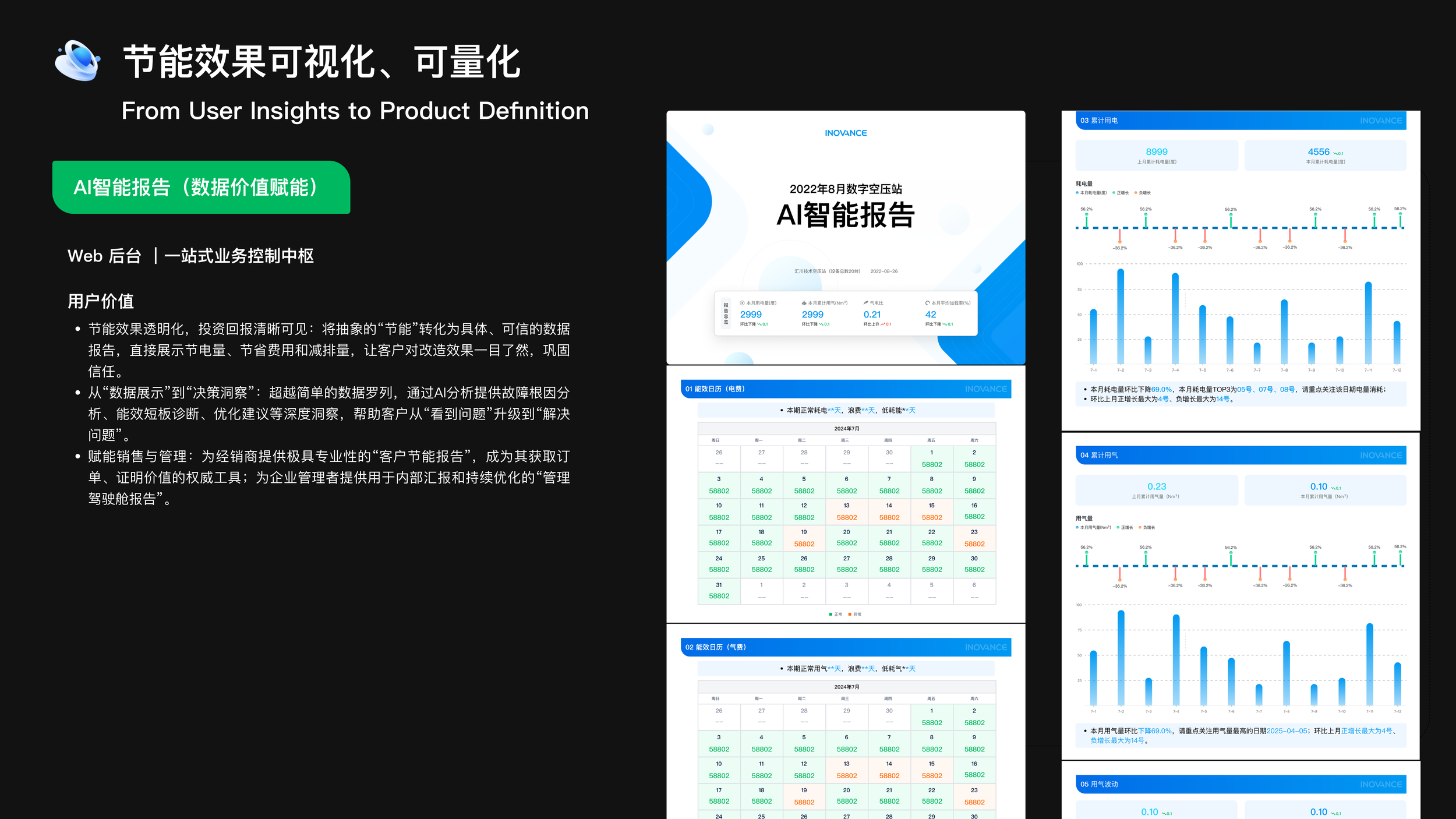
Intelligent Energy-Saving Report Design
Built automated reporting workflows that transform raw operational data into clear, structured energy-saving insights for internal reporting and customer communication.
我从体验与服务设计层面,确保节能价值可感知、可验证、可复用:
集中式 Web 管控大屏
设计统一的能耗、系统健康度与告警视图,支持日常运维与管理决策。移动端体验落地
简化操作路径适配多角色移动场景,支持实时数据查看、告警处理、远程启停等功能,满足外出 / 现场作业的便捷管控需求。
群控算法的体验表达
与算法与研发团队协作,将复杂的控制逻辑转化为用户可理解、可操作的系统行为。智能节能报告设计
构建自动化报告流程,将原始数据转化为可用于内部汇报与客户沟通的节能成果说明。
Customer Value 客户价值
Improved Operational Efficiency: Equipment status visualization combined with mobile control significantly accelerated fault response and issue diagnosis.
Quantifiable Energy Savings: Data-driven reports made energy reduction outcomes visible, measurable, and verifiable.
Enhanced Multi-Device Coordination: Enabled intelligent, coordinated scheduling across multiple compressors, avoiding single-unit overload or inefficient operation and improving overall system stability.
More Effective Management Decision-Making: Provided management with clear visibility into station operations and cost data, supporting optimized resource allocation.
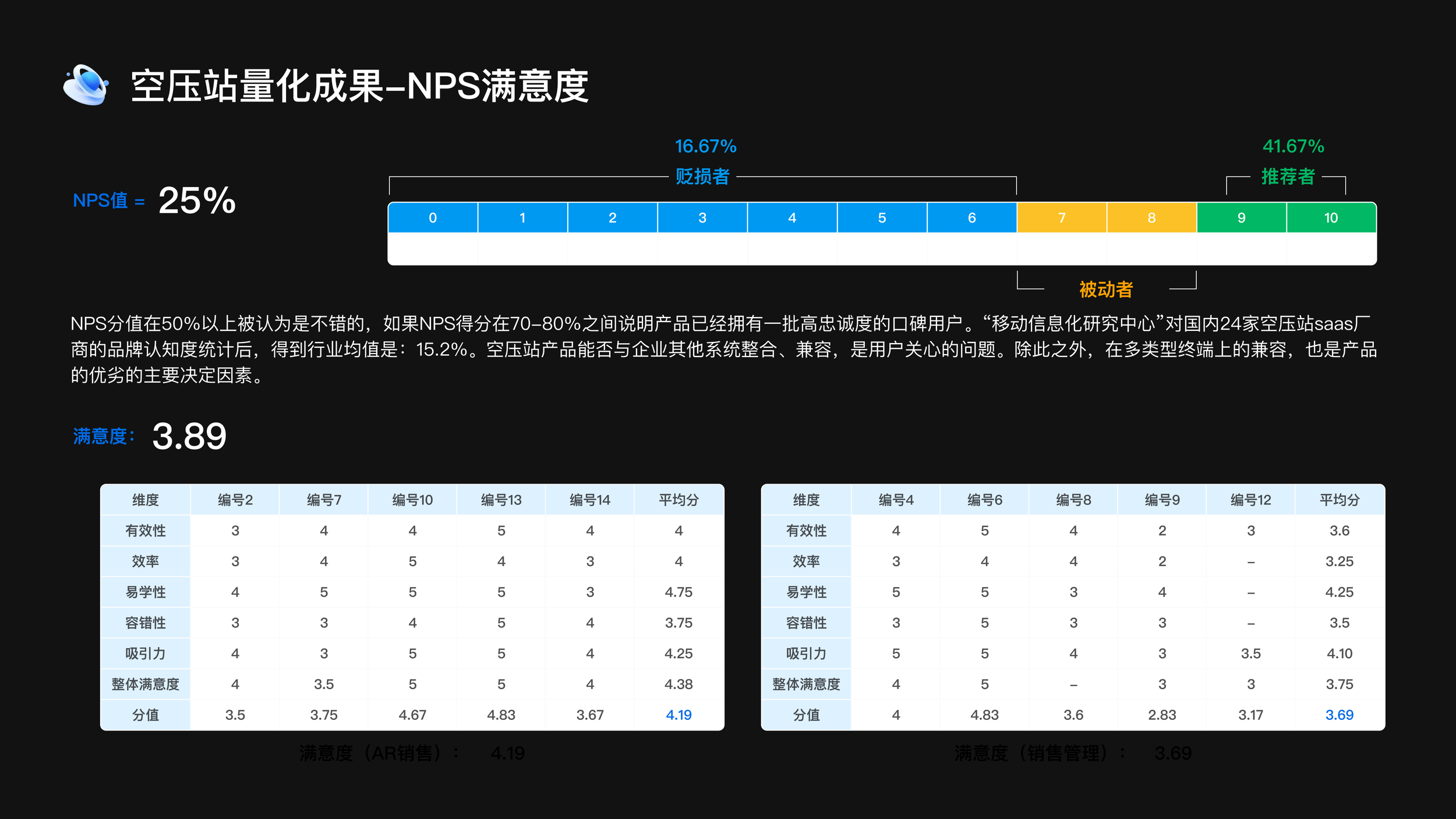
The air compressor station project has an NPS of 25% (higher than the industry average of 15.2%), with 41.67% promoters and 16.67% detractors; its overall satisfaction score is 3.89, while the satisfaction scores for AR sales and sales management are 4.19 and 3.69 respectively.
运维效率提升:设备状态可视化 + 移动化管控,故障响应与问题定位速度显著加快
节能效果可量化:通过数据报告让能耗降低成果 “可视化、可验证”
多设备联控增效:实现空压站多台设备智能协同调度,避免单机过载或低效运行,提升整体机组运行稳定性
管理决策提效:管理层获得清晰的空压站运行 / 成本数据,支撑资源优化配置
空压站项目 NPS 值为 25%(高于行业均值 15.2%),其中推荐者占 41.67%、贬损者占 16.67%,整体满意度 3.89 分,AR 销售端与销售管理端满意度分别达 4.19 分、3.69 分。
Platform 02: Air Compressor IoT Platform
平台02:空压机物联网平台
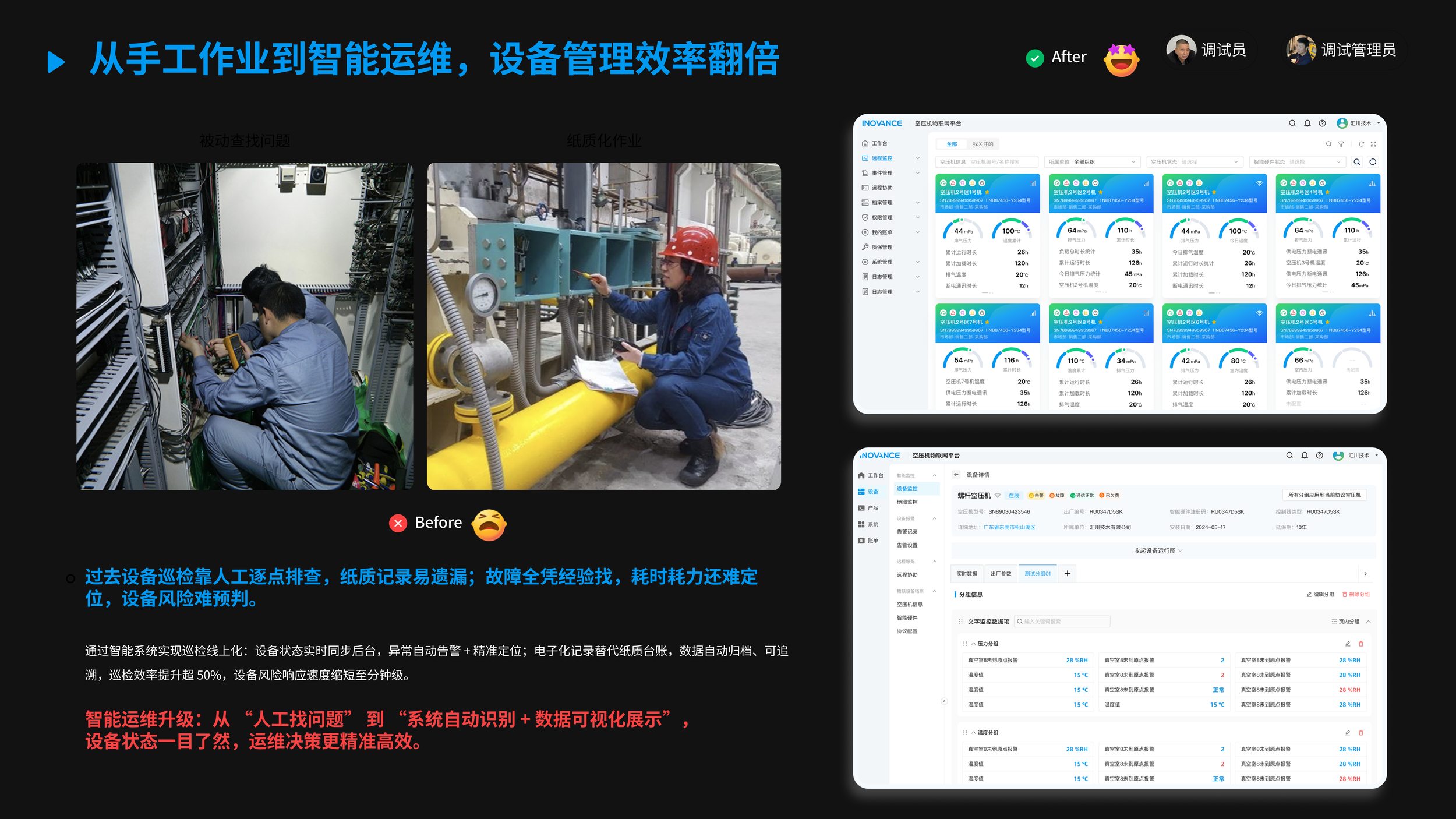
The Air Compressor IoT Platform targets device-level management scenarios for single or multiple compressors, focusing on independent monitoring and on-site operations for standalone or distributed equipment.
Customer Success Challenges Addressed
Lack of Cross-Platform Coordination: Disconnected data between Web and mobile systems prevented real-time collaboration between on-site operations and back-office management.
High Manual Dependency: Inspections and status tracking relied heavily on offline processes, leading to delays and information gaps.
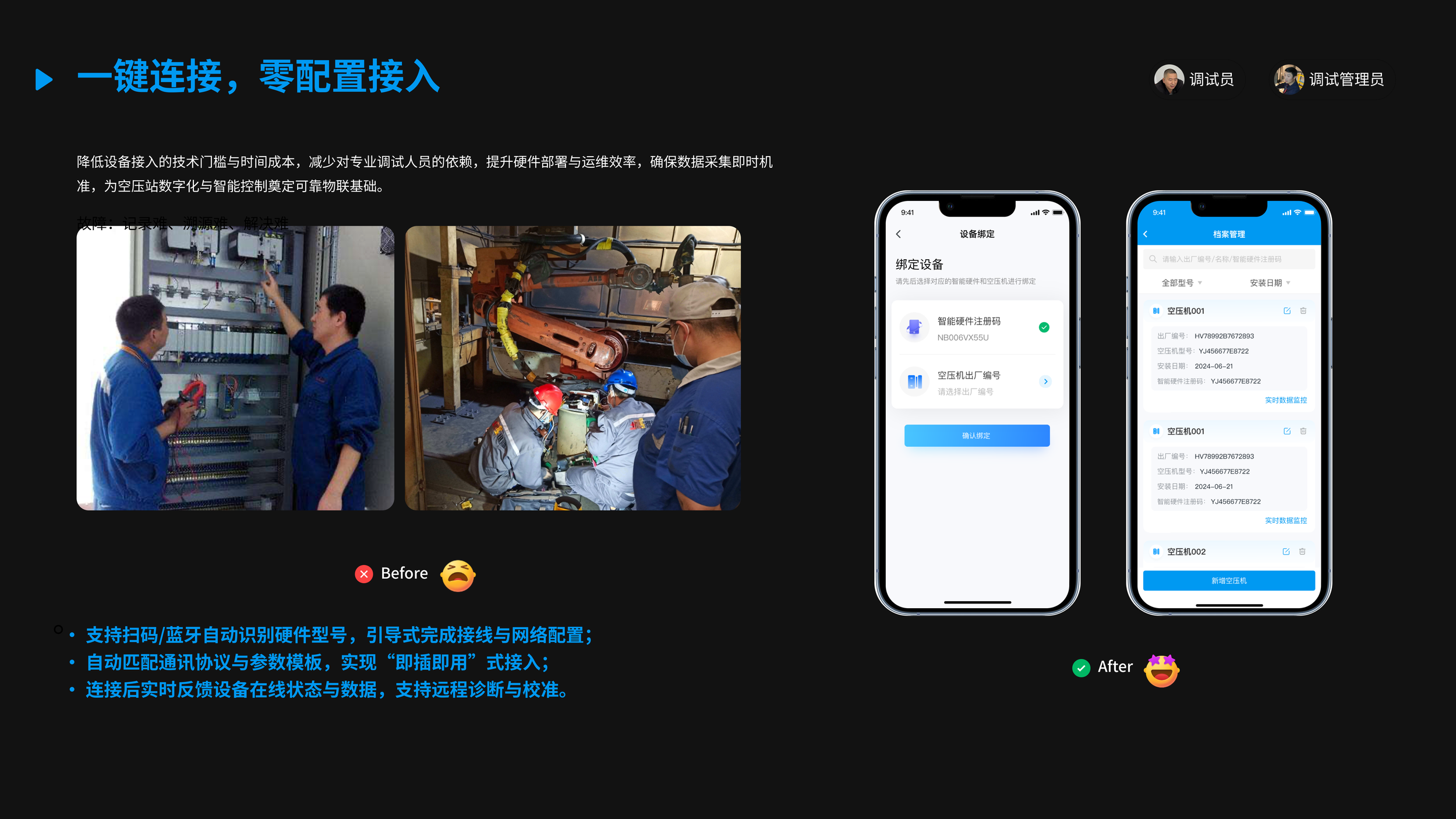
High Onboarding and Maintenance Costs: Device connectivity required specialized configuration, and troubleshooting depended largely on individual experience.
My Contribution to the Solution
Web-Based Centralized Control Experience: Designed a one-stop Web control center integrating device fleet status, energy data, and alert dashboards to enable real-time, centralized monitoring of multiple compressors.
Mobile App for On-Site Operations: Delivered an App experience tailored to field work, supporting QR-based device binding, real-time data access, alert notifications with on-site feedback, and remote start/stop—allowing technicians to complete end-to-end tasks without relying on a PC.
Seamless Cross-Platform Data Synchronization: Unified data models and interaction logic across Web and App, ensuring real-time synchronization of device status, alerts, and operation logs, and enabling smooth collaboration between centralized management and mobile field operations.
空压机物联网平台面向空压机设备级单台 / 多台管理场景,聚焦单台或分散空压机的独立监控与现场作业。
需解决的客户痛点
多端协同缺失:传统管理中 Web 端与移动端数据割裂,现场运维与后台管控无法实时联动
人工依赖度高:设备巡检、状态跟踪依赖线下作业,信息传递滞后且易遗漏
接入与运维成本高:设备联网需专业配置,后期故障排查依赖人工经验
解决方案
Web 端全局管控体验设计
构建 Web 端一站式中控界面:整合空压机设备集群状态、能耗数据、预警看板等模块,支持多设备的集中监控,支撑空压机实时监控
App 端移动运维体验落地
适配现场作业场景的 App 端设计:实现设备扫码快速绑定、实时数据查看、告警推送与现场反馈、远程启停控制等功能,让巡检员 / 维保人员脱离 PC 端即可完成全流程作业,打通 “后台 - 现场” 的协同链路
跨端数据协同体验打通
统一 Web 与 App 端的数据标准与交互逻辑,确保设备状态、告警信息、操作记录等数据实时同步,实现 “后台全局管控 + 现场移动作业” 的无缝衔接
Platform 03: Hui Service CRM Solution
平台03:汇服务 CRM 解决方案
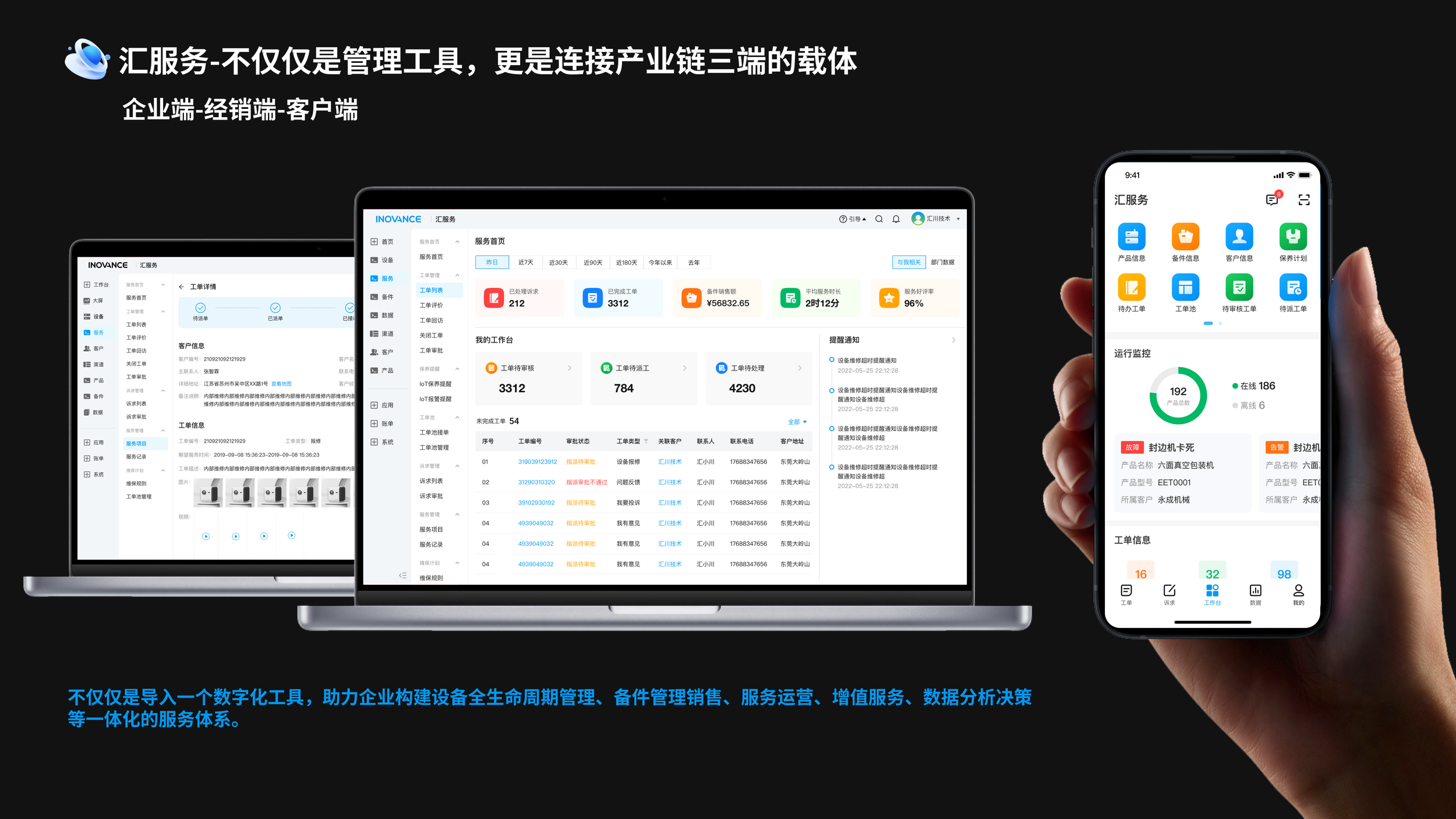
The Hui Service CRM Platform acts as a carrier connecting enterprises, distributors, and clients, building an integrated service system covering the entire lifecycle of equipment, parts, and services across Web and App terminals.
汇服务 CRM 平台是连接企业端 - 经销端 - 客户端的载体,通过 Web 与 App 端构建覆盖设备、备件、服务全生命周期的一体化服务体系。
Customer Success Challenges Addressed
Fragmented Service Workflow: Disconnected data across enterprises, distributors, and customers; offline work orders were manual and slow to respond.
Lack of Service Transparency: No real-time visibility into service progress or spare-part flows; issue resolution relied heavily on individual experience.
Reactive Service Model: No predictive maintenance, inefficient spare-part management, and limited conversion of service value into revenue.
解决的客户痛点
服务链路割裂:企业、经销商、客户间数据不通,线下工单操作繁琐、响应滞后
现场服务不透明:服务进度、备件流转无实时记录,故障处理依赖人工经验
被动服务模式:设备维护无预判,备件管理低效,服务价值无法转化为营收
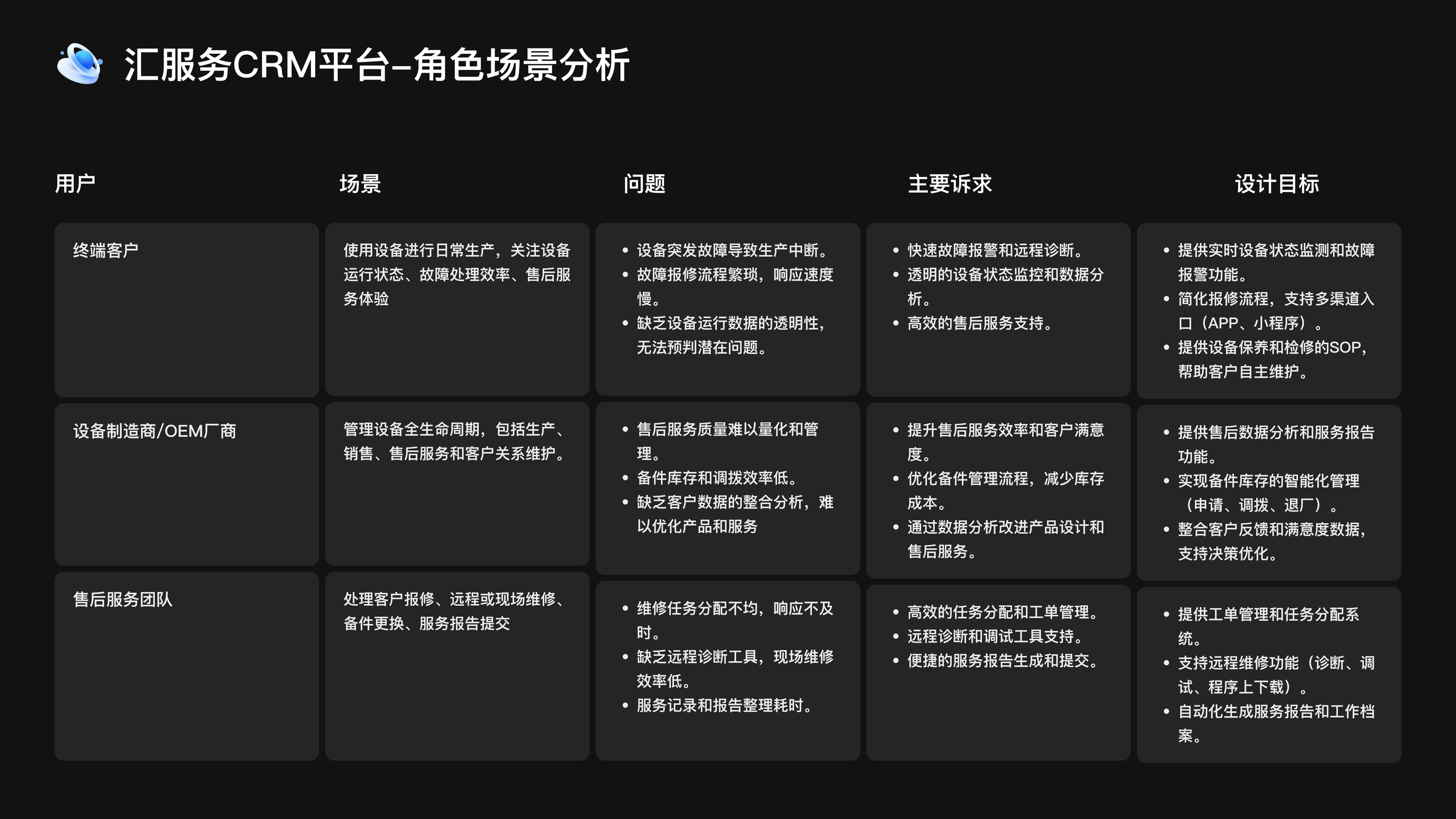
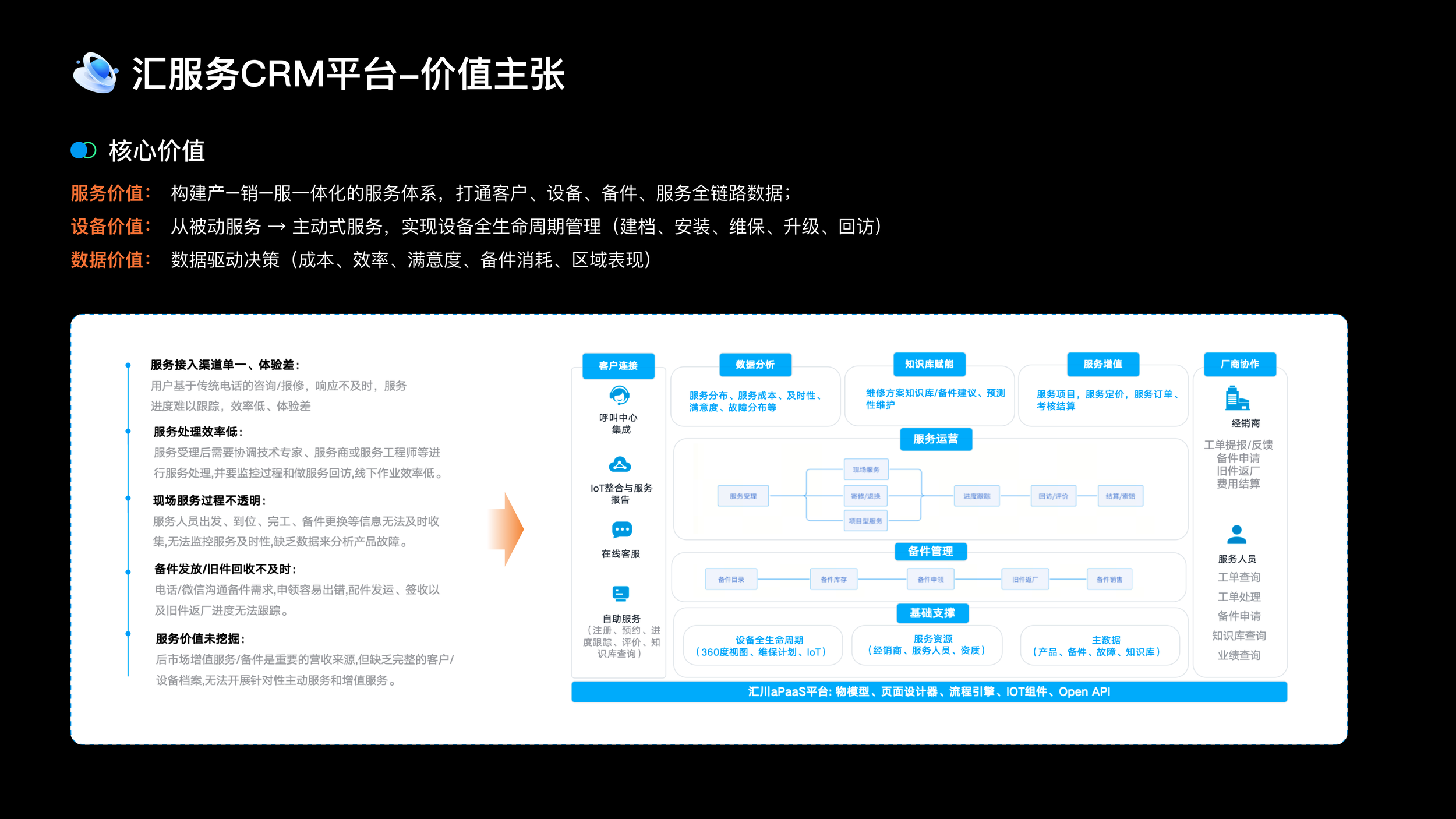
定位了三类核心角色:终端客户、设备制造商/OEM厂商、售后服务团队,针对他们在服务场景中的行为与痛点展开调研。通过深度访谈与实地走访,我们发现:
终端客户的核心问题是“设备突发故障导致生产中断”和“报修流程繁琐”。他们希望快速故障报警和远程诊断,能随时看到设备运行状态,报修能像点外卖一样简单、透明。
设备制造商/OEM的痛点在于“售后服务质量难以量化”“备件库存调拨效率低”“客户数据分散无法整合分析”。他们需要提升售后服务效率、优化备件管理、通过数据分析改进产品设计。
售后服务团队面临“维修任务分配不均”“缺乏远程诊断工具”“服务报告整理耗时”等问题。他们需要高效的任务分配、远程维修工具支持、自动化生成服务报告。基于这些洞察,我们进一步将痛点聚焦到五个核心问题:服务接入渠道单一体验差、服务处理效率低、现场服务过程不透明、备件发放与旧件回收不及时、服务价值未被挖掘。
在洞察落地阶段,我将用户洞察转化为汇服务的设计策略和核心能力。
首先是价值主张的清晰定义。汇服务的核心价值是构建“产—销—服”一体化的服务体系,打通客户、设备、备件、服务全链路数据;推动从被动服务向主动式服务转型,实现设备全生命周期管理;通过数据驱动决策,帮助OEM在成本、效率、满意度、备件消耗、区域表现等维度获得量化支撑。
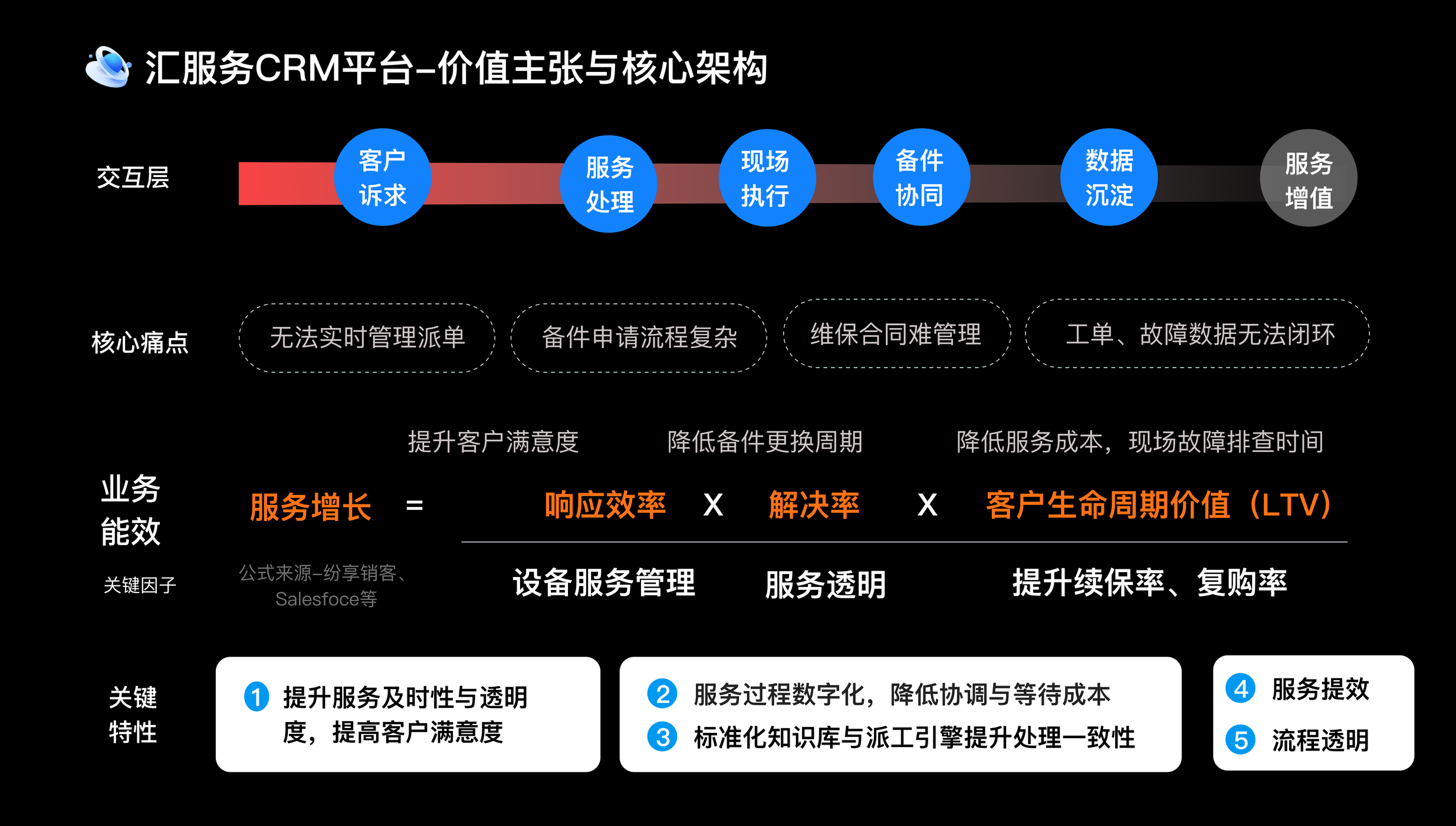
交互层:我们定义了汇服务需要打通的六个关键环节:客户诉求、服务处理、现场执行、备件协同、数据沉淀、服务增值。这六层构成了一个完整的服务闭环,从客户发起诉求开始,到最终形成服务增值结束。
核心痛点:我们通过用户洞察,聚焦了四个高频高影响的问题:无法实时管理派单、备件申请流程复杂、维保合同难管理、工单与故障数据无法闭环。这些都是OEM售后服务部门在日常运营中真实面临的痛点。
业务能效: 这一层是我们设计的价值目标:提升客户满意度、降低备件更换周期、降低服务成本、缩短现场故障排查时间。同时,我们引入了关键因子的概念——服务增长、响应效率、解决率、客户生命周期价值(LTV),这些指标来自纷享销客、Salesforce等成熟CRM产品的实践,确保我们的设计有可量化的业务目标支撑。
关键特性:基于以上洞察和目标,我们提炼出五大设计原则:提升服务及时性与透明度、服务过程数字化降低协调成本、标准化知识库与派工引擎提升一致性、服务提效、流程透明。这五条特性直接指导了后续的产品功能设计。
提炼五大核心场景的解决方案:
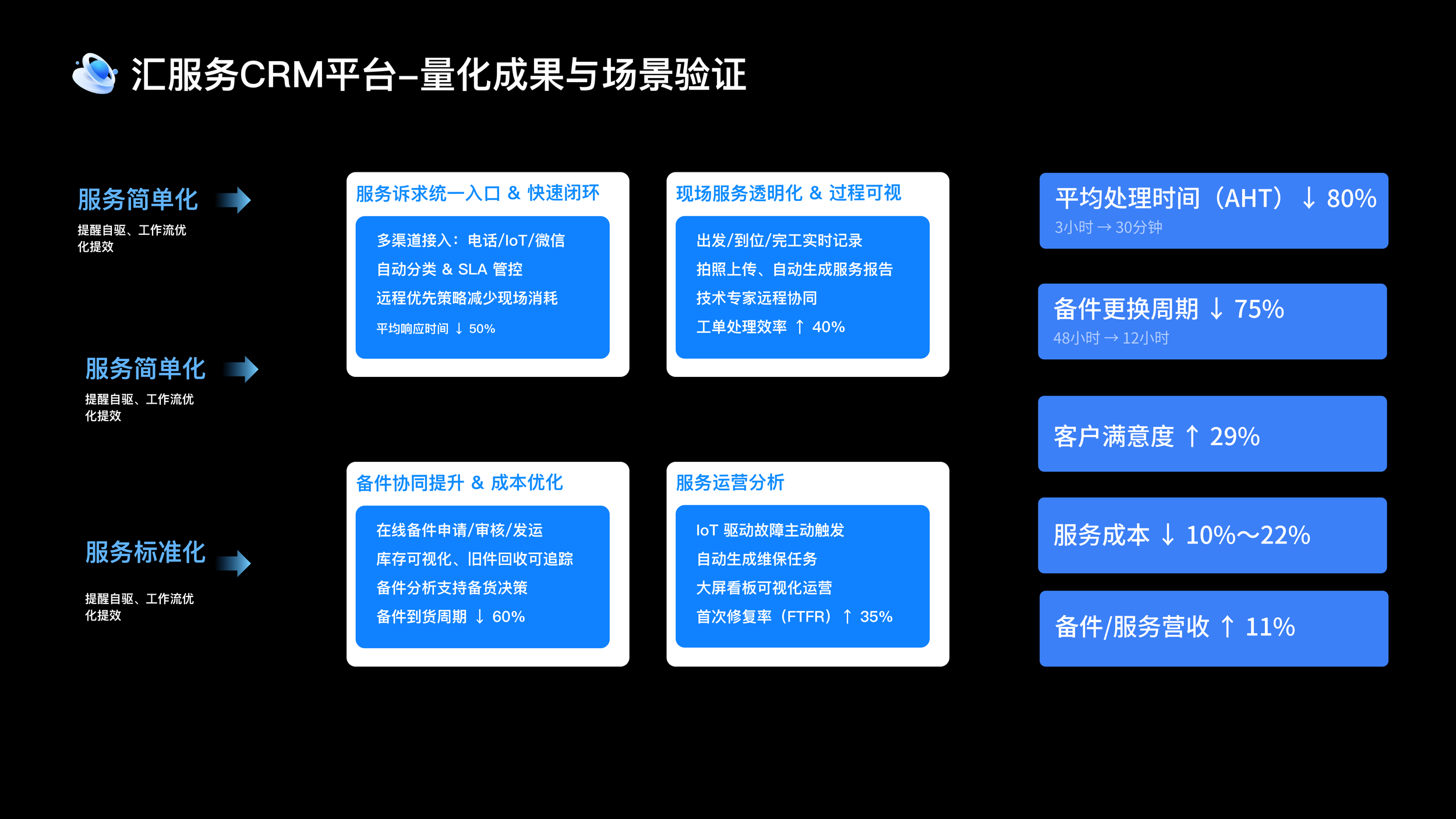
第一,服务诉求统一入口与快速闭环。设计了多渠道接入(电话、IoT、微信),实现自动分类与SLA管控,并采用远程优先策略减少现场消耗。这一设计使平均响应时间缩短了50%。
第二,现场服务透明化与过程可视。通过移动端App实现出发、到位、完工实时记录,拍照上传自动生成服务报告,并支持技术专家远程协同。工单处理效率提升了40%。
第三,备件协同提升与成本优化。实现在线备件申请、审核、发运全流程线上化,库存可视化、旧件回收可追踪,备件分析支持备货决策。备件到货周期缩短了60%。
第四,服务运营分析。通过IoT驱动故障主动触发,自动生成维保任务,结合大屏看板可视化运营,首次修复率提升了35%。
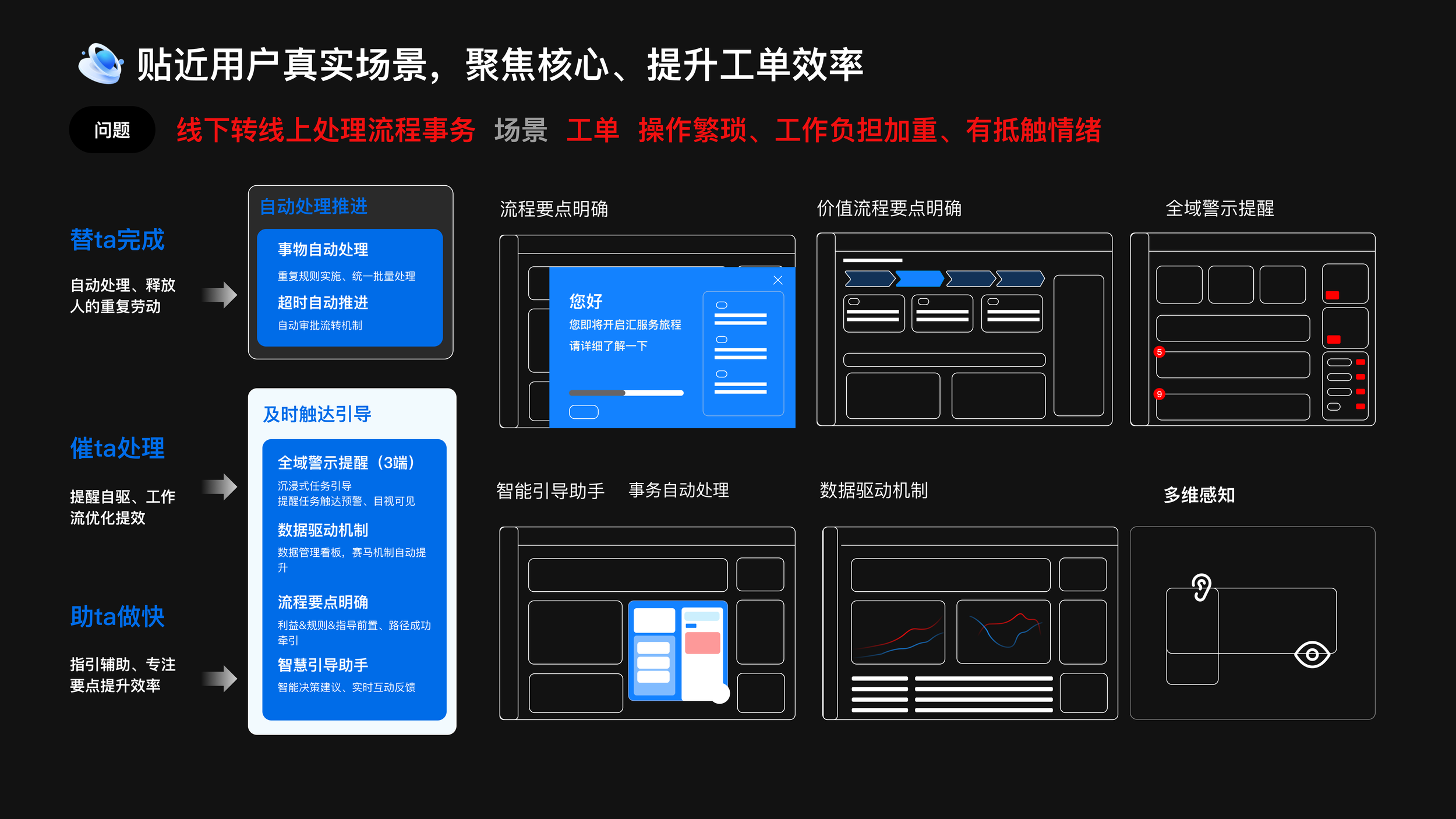
第五,贴近用户真实场景的效率提效机制。我们洞察到一线服务人员对工单系统有“操作繁琐、负担加重”的抵触情绪,因此设计了“自动处理推进”“及时触达引导”“助ta做快”三层机制——通过事件自动处理释放重复劳动,通过全域警示提醒和沉浸式任务引导减少遗漏,通过流程要点前置和智能引导助手降低学习成本,真正实现了从“人找事”到“事找人”的转变。
Results 结果
Service Efficiency Gains: Average handling time reduced by 80% (from 3 hours to 30 minutes); work order efficiency improved by 40%.
Cost and Experience Optimization: Spare-part replacement cycles shortened by 75%, customer satisfaction increased by 29%, and service costs reduced by 10%–22%.
Business Value Creation: Spare-part and service revenue increased by 11%, enabling a shift from reactive service to proactive, value-added service.
服务效率提升:平均处理时间缩短 80%(3 小时→30 分钟),工单处理效率提升 40%
成本与体验优化:备件更换周期缩短 75%,客户满意度提升 29%,服务成本降低 10%-22%
商业价值转化:备件 / 服务营收增长 11%,实现从被动服务到主动增值的模式升级
My Work & Outcomes 我的成果
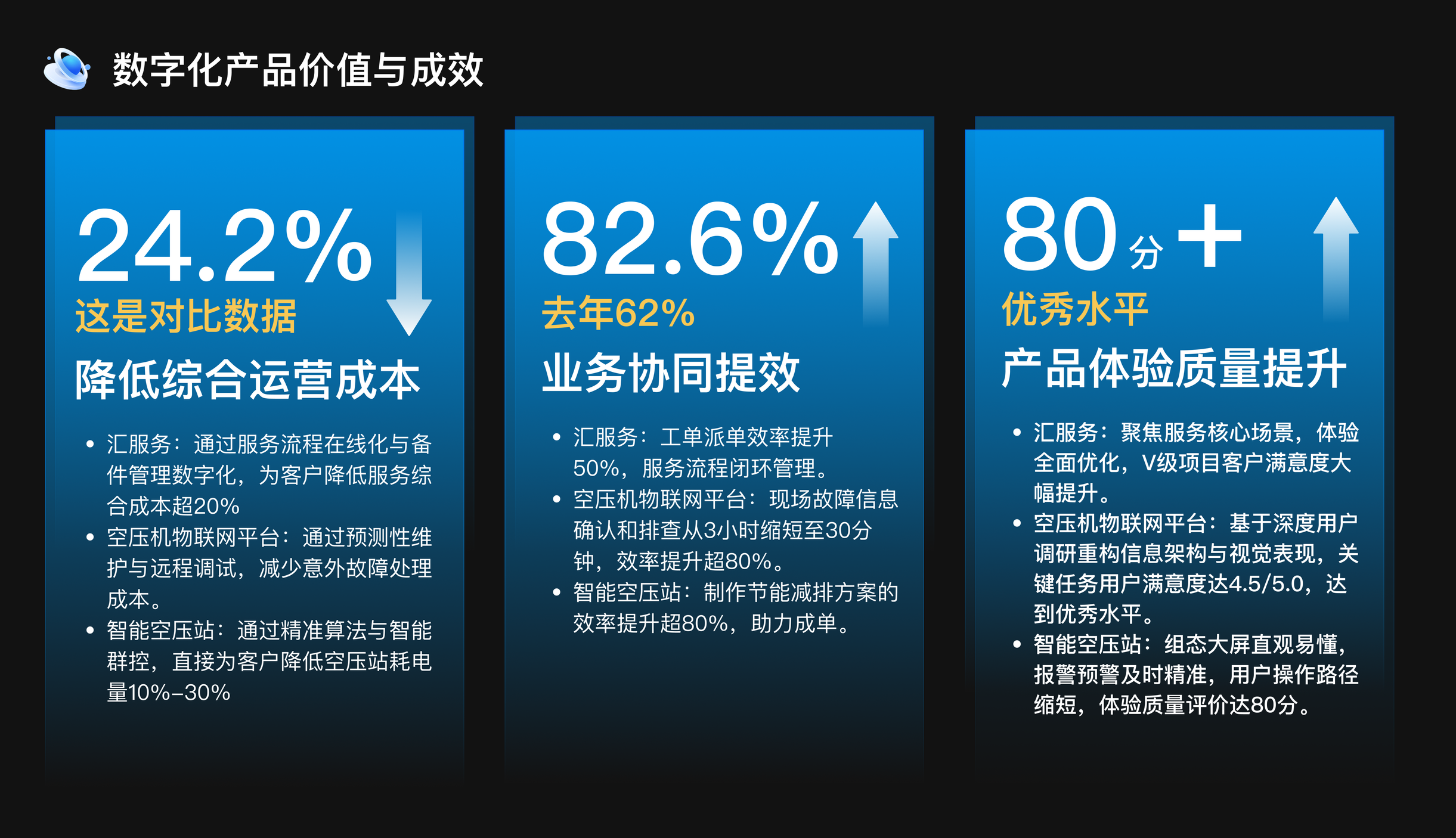
I led the experience and value integration across three interconnected platforms — Hui Service CRM, Air Compressor IoT, and Smart Air Station — while building a reusable knowledge base to support long-term scalability.
At the platform level, I translated complex operational data and service processes into clear, quantifiable value across cost, efficiency, and experience, ensuring that outcomes were visible, credible, and decision-ready for different stakeholders.
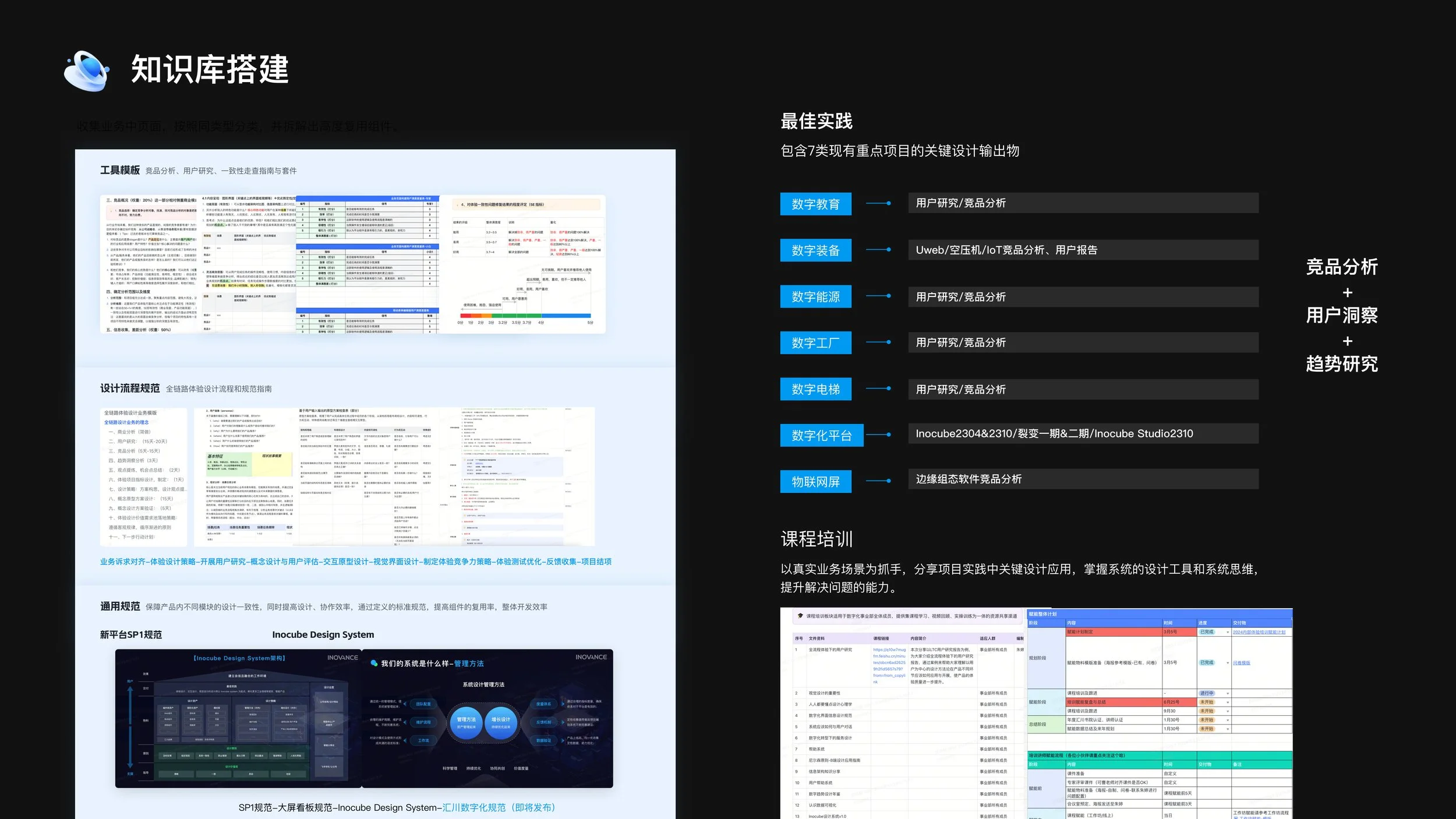
At the system level, I established a structured knowledge base by creating toolkits, templates, and best-practice patterns, enabling experience standardization, team empowerment, and faster iteration across projects.
Key Outcomes
Platform Impact
24.2% reduction in comprehensive operational cost
82.6% improvement in cross-business collaboration efficiency
Product experience quality rated 80+, with measurable satisfaction and adoption gains
Capability & System Impact
Higher design efficiency and experience reusability
Stronger cross-team design consistency
A sustainable experience iteration mechanism supporting future platform evolution
This project demonstrates how experience design can move beyond interface optimization to become a strategic enabler of customer success, operational efficiency, and scalable growth.
我作为体验与服务设计负责人,统筹了 汇服务 CRM、空压机物联网、智能空压站 三大平台的体验与价值整合,并搭建了支撑长期演进的设计与知识体系。
在平台层面,我将复杂的设备数据与服务流程,转化为在成本、效率与体验维度可量化、可感知、可决策的客户价值,帮助不同角色清晰理解数字化投入所带来的实际收益。
综合运营成本降低 24.2%
业务协同效率提升至 82.6%
产品体验质量稳定在 80 分以上,用户满意度与使用意愿显著提升
在体系层面,我通过构建工具模板、方法框架与最佳实践库,推动设计标准化与能力沉淀,实现团队赋能与项目复用。
设计效率与经验复用性显著提升
跨团队体验一致性增强
构建了支持持续演进的体验迭代与能力成长机制
该项目不仅验证了体验设计在工业场景中的落地价值,也证明了其在客户成功、业务效率与规模化增长中的战略作用。