01|Project Overview
The SLM Platform project redefined the user experience and business strategy for Inovance’s industrial IoT ecosystem, transitioning from Uweb 2.0 to SLM 3.0.
In an era when industrial internet platforms are becoming the backbone of digital transformation, this initiative aimed to unify fragmented systems, improve usability, and strengthen market competitiveness.The research identified core user pain points across engineers, OEMs, and enterprise clients — guiding the PRD, roadmap, and commercial rollout of a next-generation IoT platform that balances low-cost scalability, high compatibility, and business value delivery.
SLM平台项目旨在重塑汇川技术的工业物联网生态体系,实现从 Uweb 2.0 向 SLM 3.0 的战略升级。
在工业互联网已成为企业数字化核心基建的背景下,本项目聚焦于统一分散系统、提升易用性与商业竞争力,为公司数字化战略提供基础支撑。
研究聚焦OT工程师、OEM客户及企业决策层等核心用户群,通过系统化的调研与数据分析,识别关键痛点,指导PRD与产品路线规划,助力平台实现低成本扩展、高兼容能力与客户价值增长的平衡。
核心目标:挖掘不同层级用户的核心痛点与真实需求,定位产品体验的核心问题,输出可落地的产品优化策略和业务流程改进方案,为IoT平台重构奠定数据和需求基础。
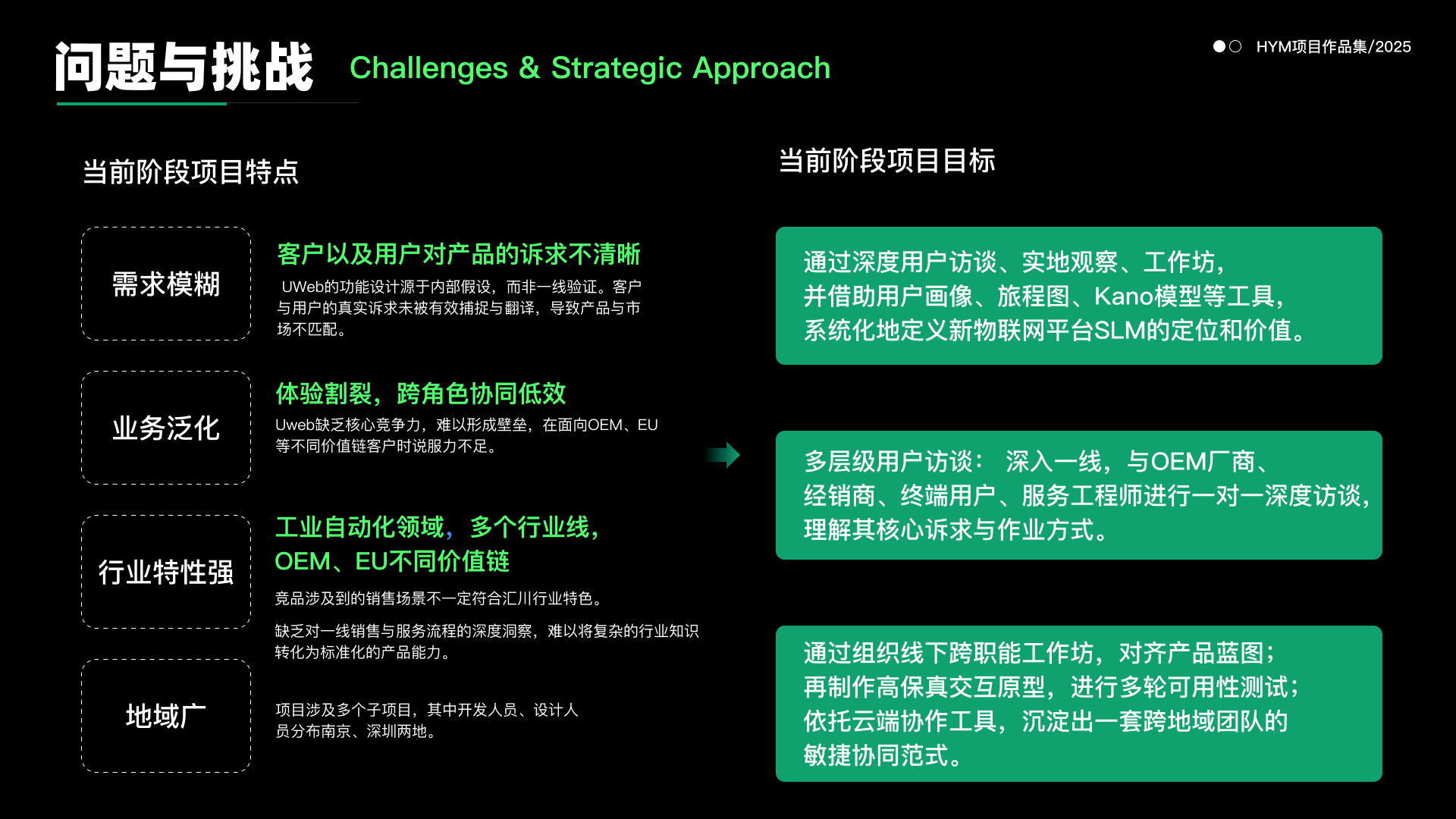
02|Research Objectives 研究目标
Through interviews with 13 stakeholders (IoT engineers, OEMs, internal teams), the research aimed to:
Deliver a low-cost, high-autonomy IoT solution
Optimize business workflows and product usability
Strengthen customer retention and brand reputation
Target Users: OEM manufacturers / Distributors / Enterprise clients
Application Scenarios:
Device monitoring, remote debugging, cloud dashboards
OEM white-label digital solutions
Customer operation and after-sales analysis
Private deployment for enterprise clients
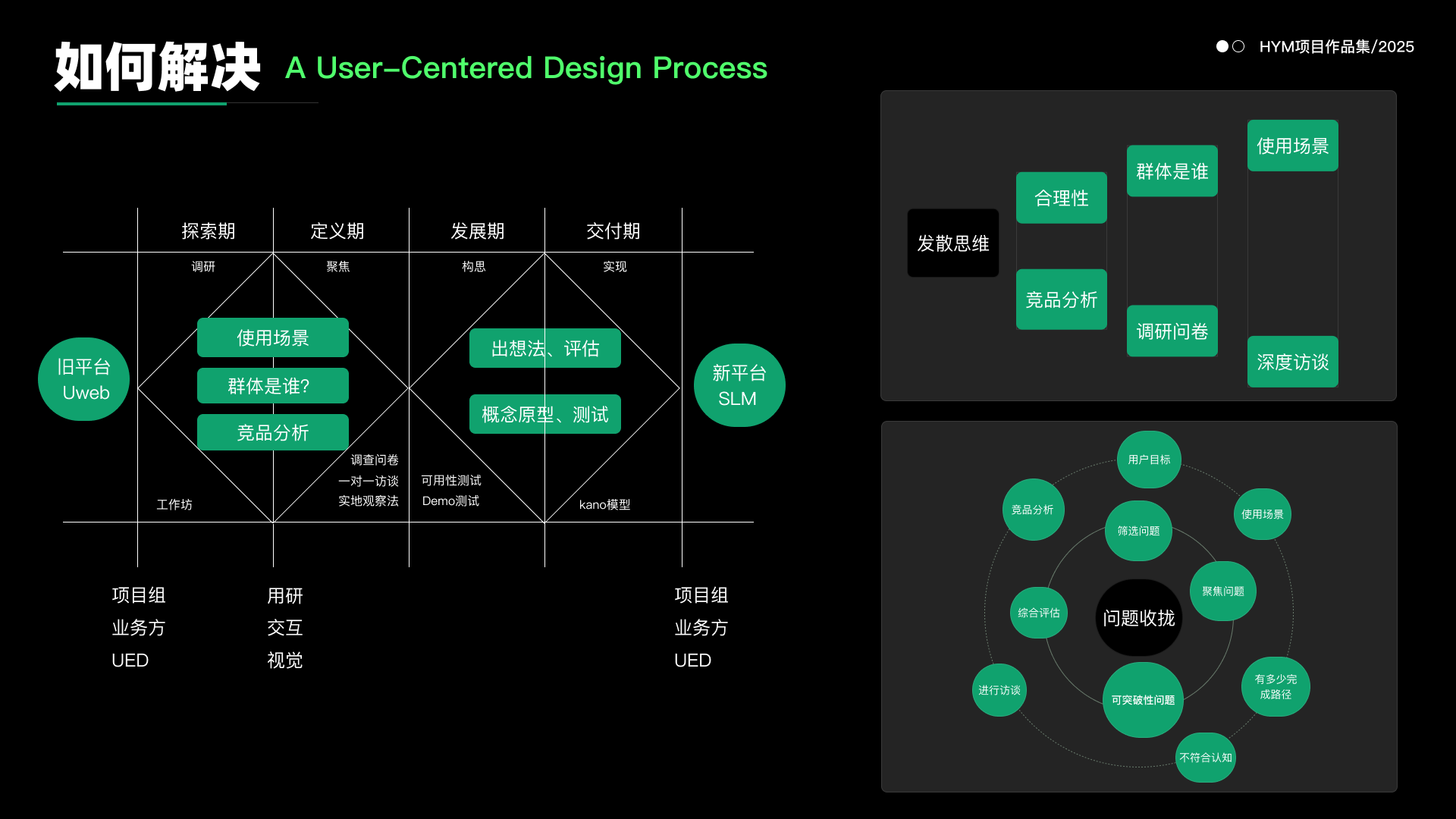
我采用了定性 + 定量结合、多角色全覆盖的调研方法,先搭建了完整的调研体系,首先梳理出项目的核心利益相关者,包括高阶决策用户(企业老板、技术主管)、实操用户(OT 工程师、销售)、内部执行团队(研发、产品)等,再针对性设计调研方案。用户招募上,精准划分了小白用户(0.5-2 年经验 OT 工程师)、专家用户(5 年以上技术主管 / 销售)、高阶用户(企业负责人 / OEM 技术主管)三类群体,最终完成 13 名核心用户的深度访谈。
本次研究旨在:提供低成本、自主性强的物联网平台解决方案;优化业务流程与产品体验;提升客户粘性与品牌口碑
目标用户: OEM制造商 / 经销商 / 企业客户
应用场景:设备连接与管理、远程调试与云端看板;OEM厂商数字化解决方案;客户运营与售后数据分析;面向企业客户的私有化部署
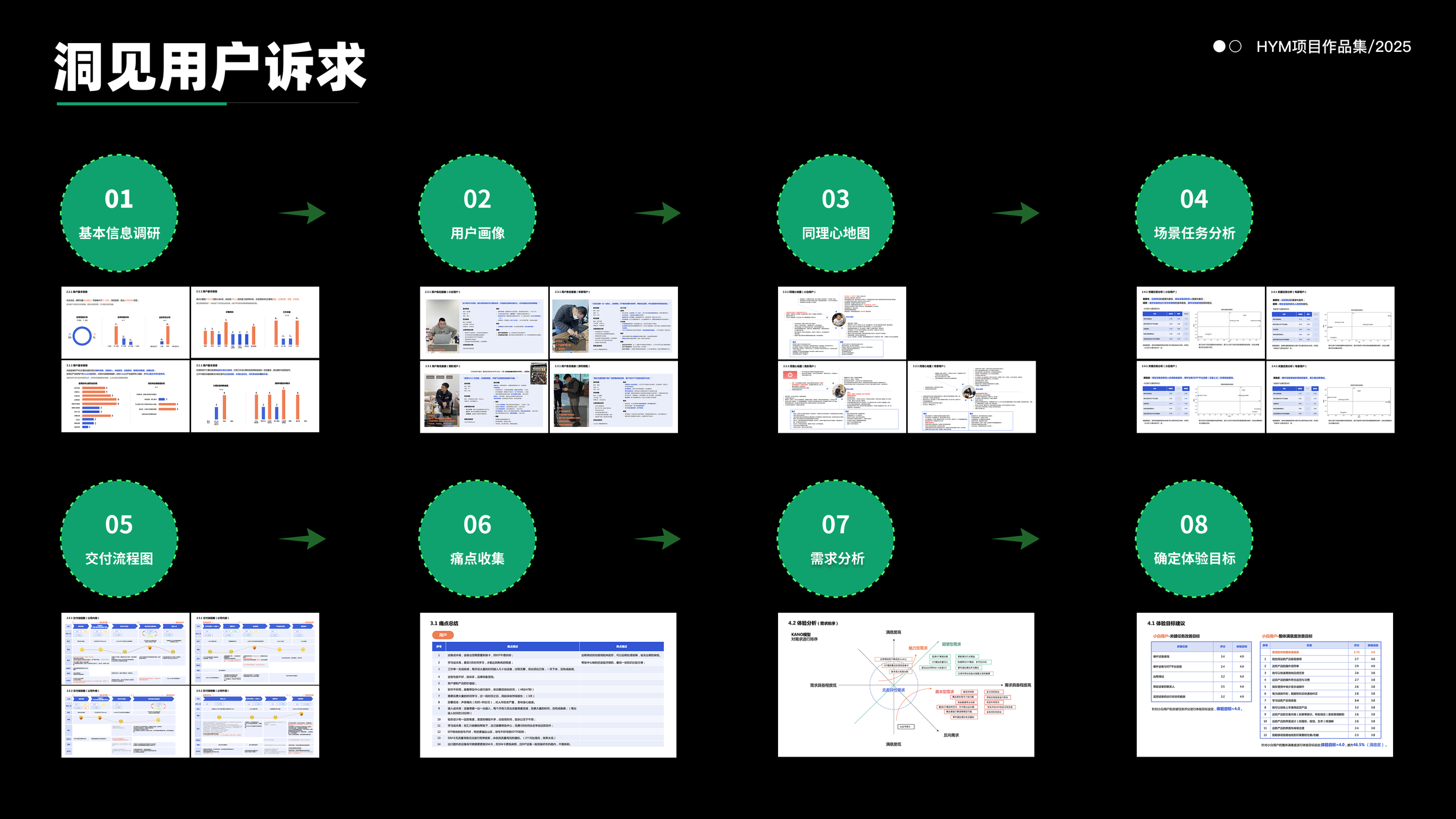
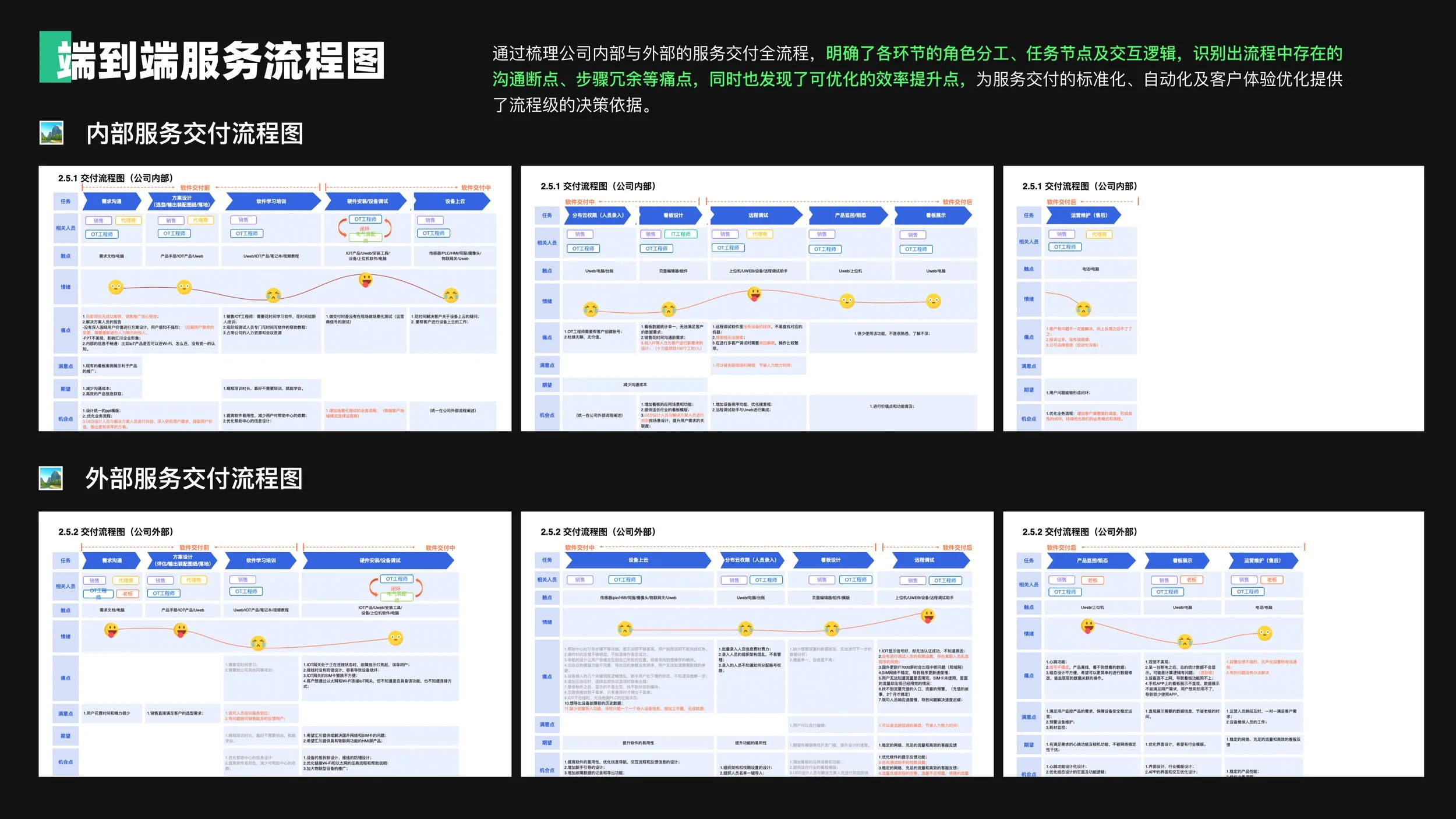
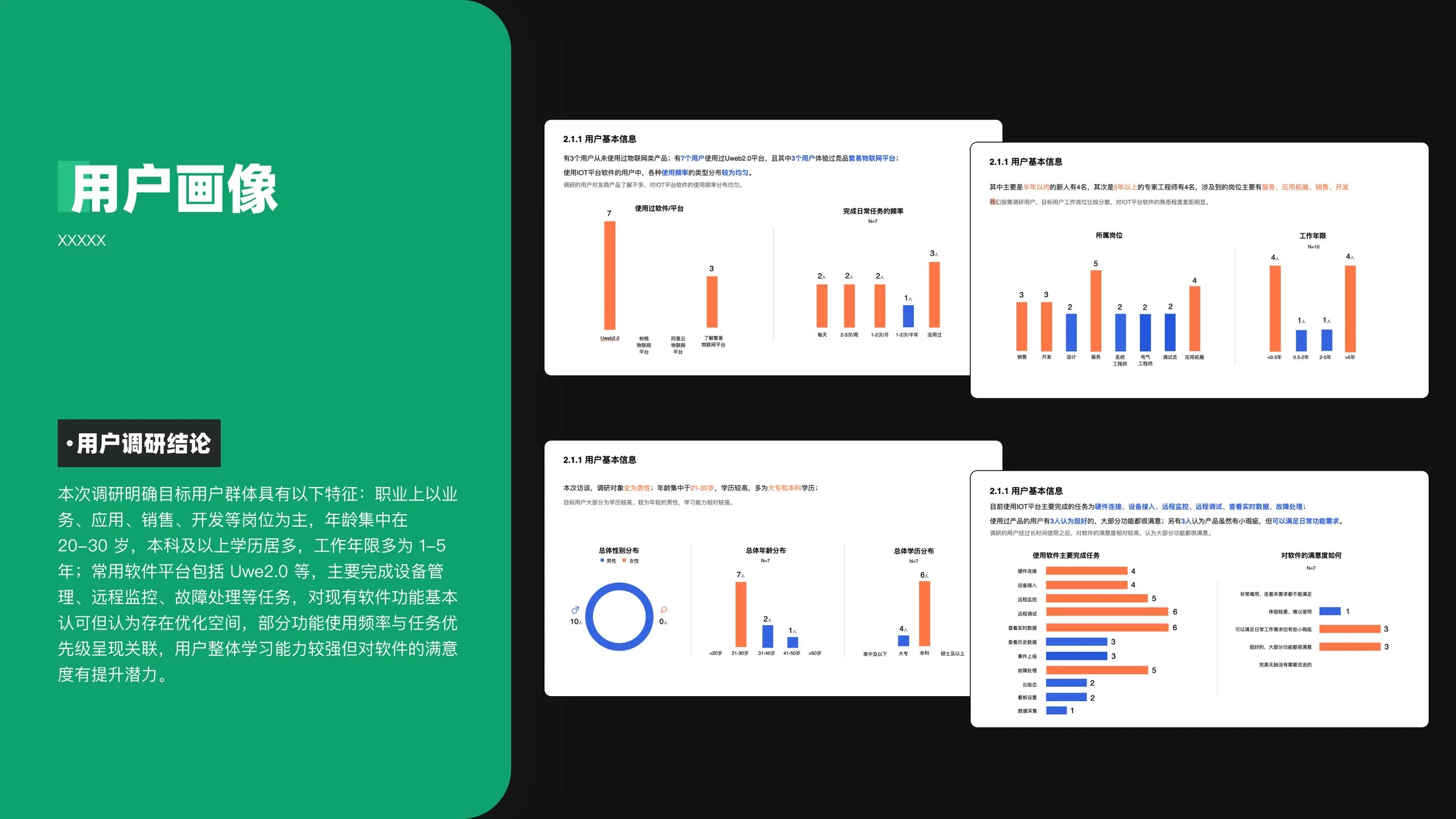
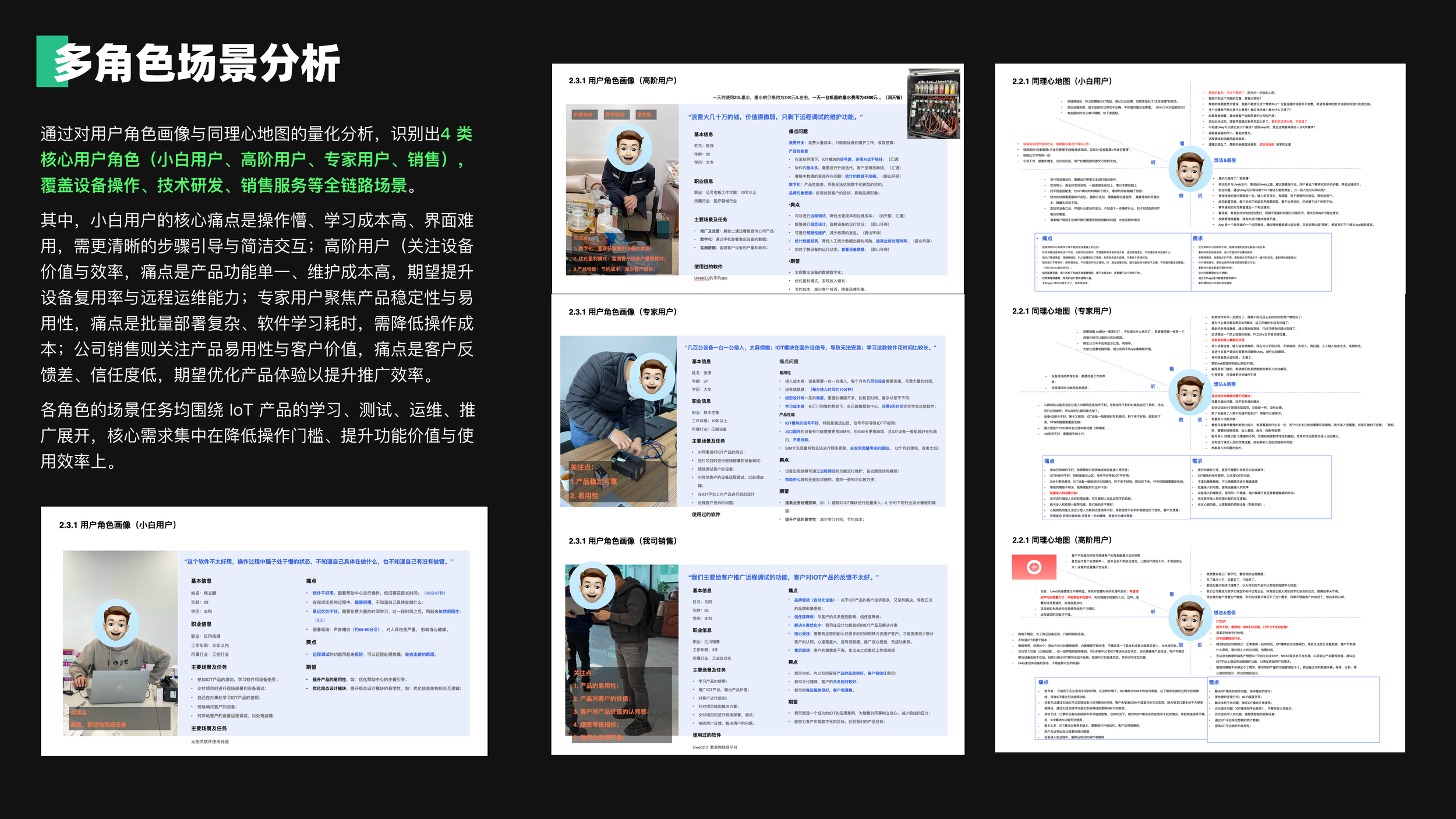
调研执行中,我重点聚焦用户核心操作任务(如硬件设备接线、设备上云、远程调试、数据监控等),全程跟进可用性测试,记录用户操作全流程数据(任务完成时间、成功率、操作卡点);同时通过用户画像、同理心地图、场景任务分析、端到端交付流程图等工具,对调研数据进行系统化拆解和分析。比如我们发现小白用户完成设备上云平均耗时 26 分钟,成功率仅 33.3%,核心痛点是操作步骤繁琐、引导不足;专家用户存在批量设备接入效率低、信号不稳定等问题;销售则反馈客户对产品价值感知弱、推广难度大。
03|Quantitative Findings 量化分析
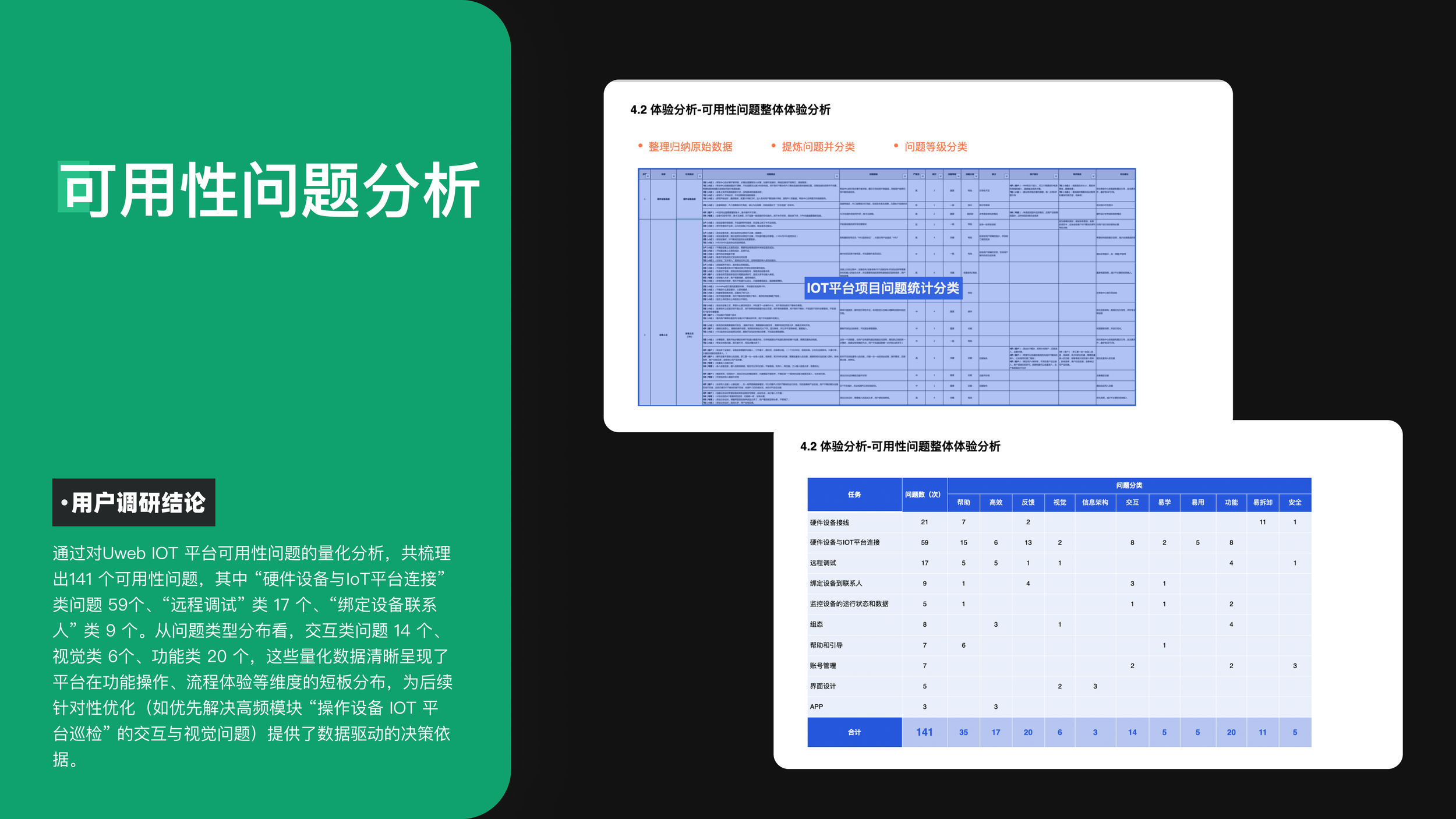
Quantitative analysis revealed 141 usability issues across the Uweb IoT platform, with the highest concentration in hardware–platform connectivity (59 issues) and remote debugging (17 issues) — both directly impacting service efficiency and task success.
Scenario-level data further showed a clear capability gap between user types:
small business users reported lower satisfaction (2.73/5.0) than professional users (2.83/5.0), while both groups rated remote debugging as a high-importance task.
These findings guided prioritization toward high-frequency, high-impact scenarios, shifting optimization focus from adding features to improving workflow clarity, interaction feedback, and task success rates.
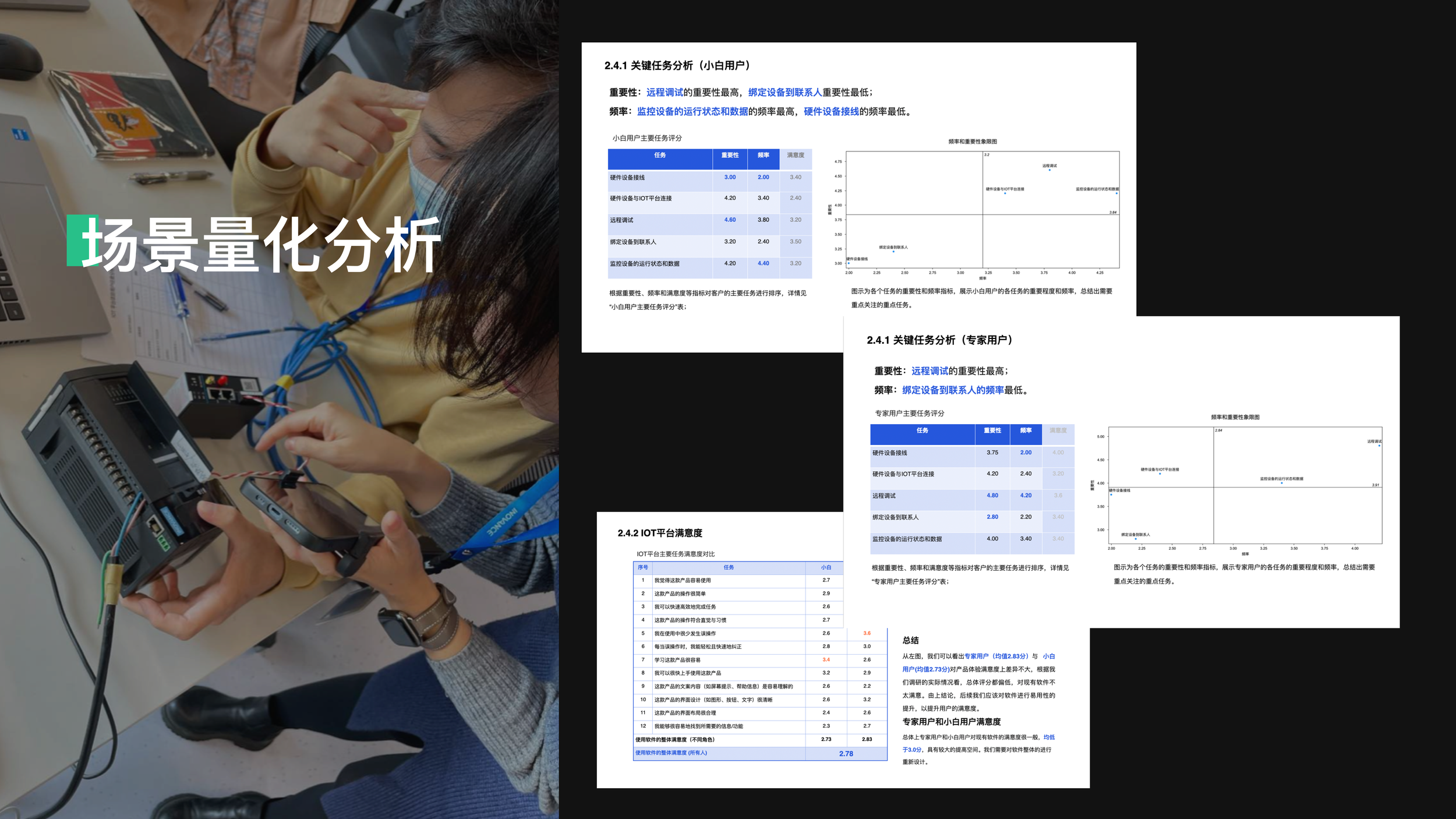
量化分析共识别出 Uweb IoT 平台 141 个可用性问题,其中硬件与平台连接(59 个)与远程调试(17 个)为最集中的高频痛点,直接影响服务效率与任务完成率。
基于上述洞察,优化策略聚焦于高频、高影响场景,将设计重心从功能堆叠转向流程清晰度、交互反馈与任务成功率的提升。
场景分析进一步显示,不同用户能力存在明显差异:
小白用户整体满意度仅 2.73/5.0,低于专业用户的 2.83/5.0,但两类用户均将远程调试视为高重要度任务。
04|Experience Goals & Prioritization Framework
Customer Experience Goal Setting
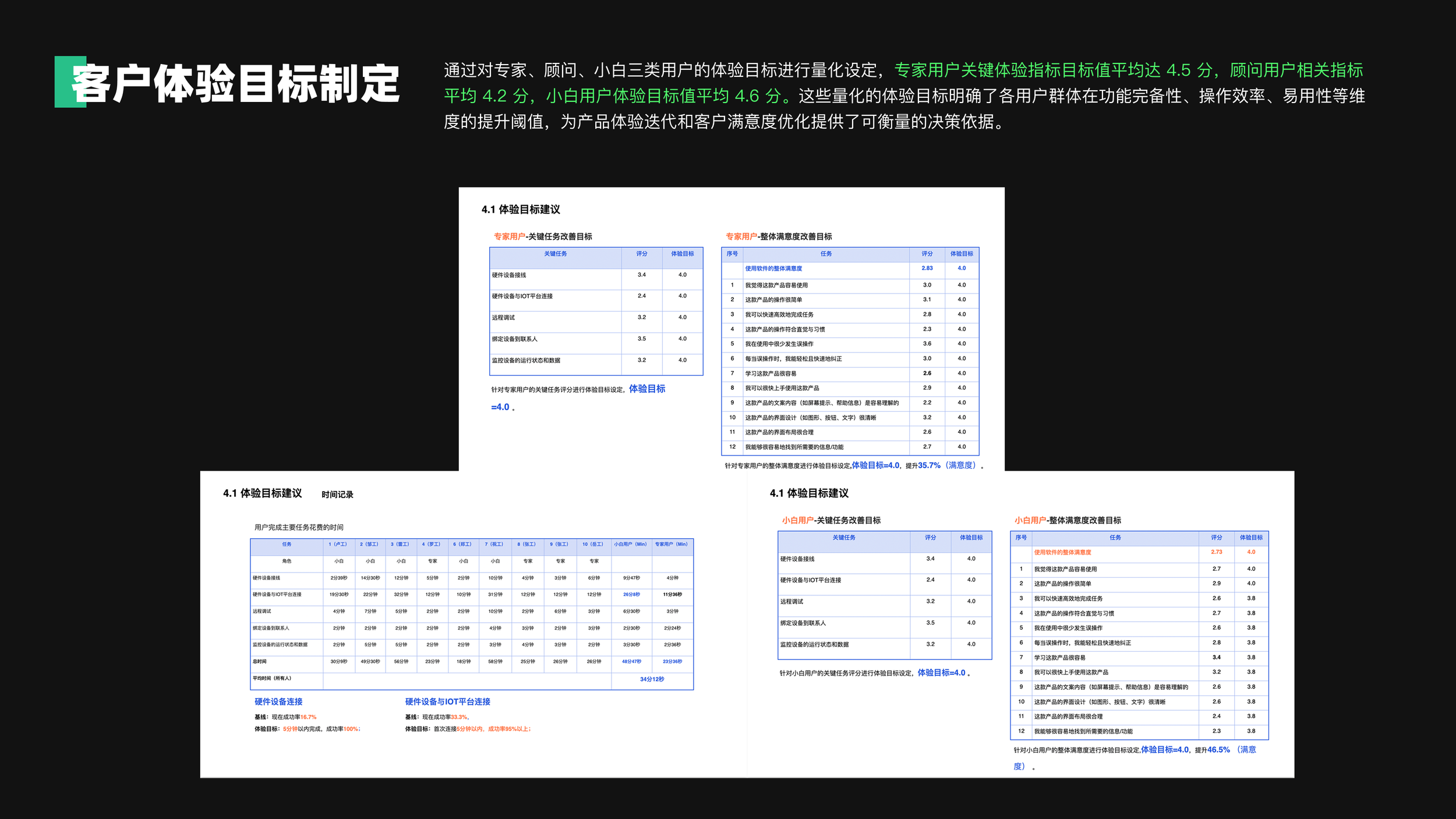
Clear, measurable experience targets were defined for three core user groups: experts, consultants, and novice users. Target satisfaction scores were set at 4.5–4.6 for expert and novice users, and 4.2 for consultants, providing a shared benchmark for improving usability, efficiency, and functional reliability across iterations.
KANO-Based Demand Prioritization
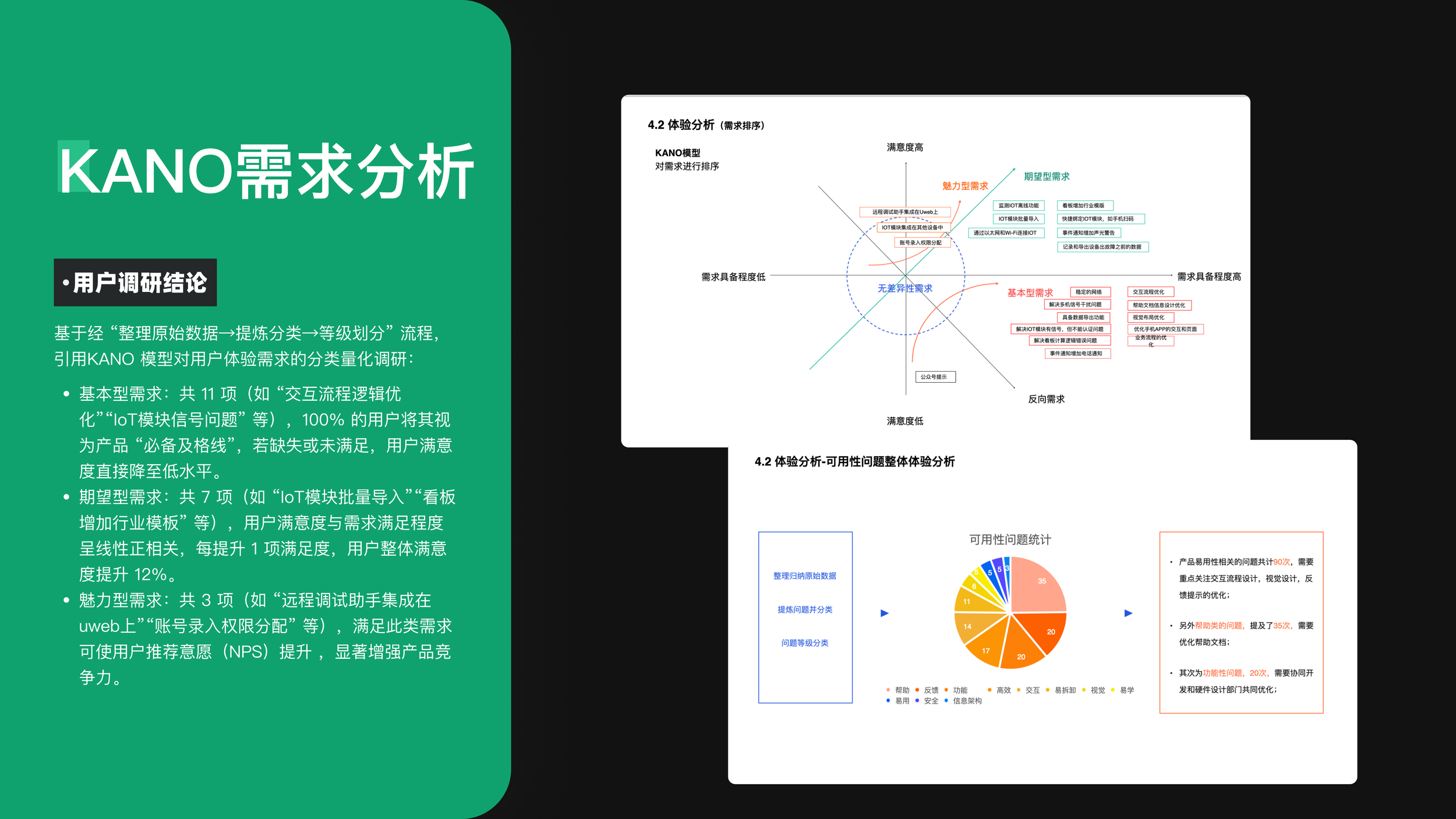
User needs were structured using the KANO model, identifying 11 basic needs, 7 performance needs, and 3 excitement needs. Combined with usability issue distribution, this framework helped prioritize improvements that would deliver the greatest impact on user satisfaction and business value.
Competitive Benchmarking & Differentiation
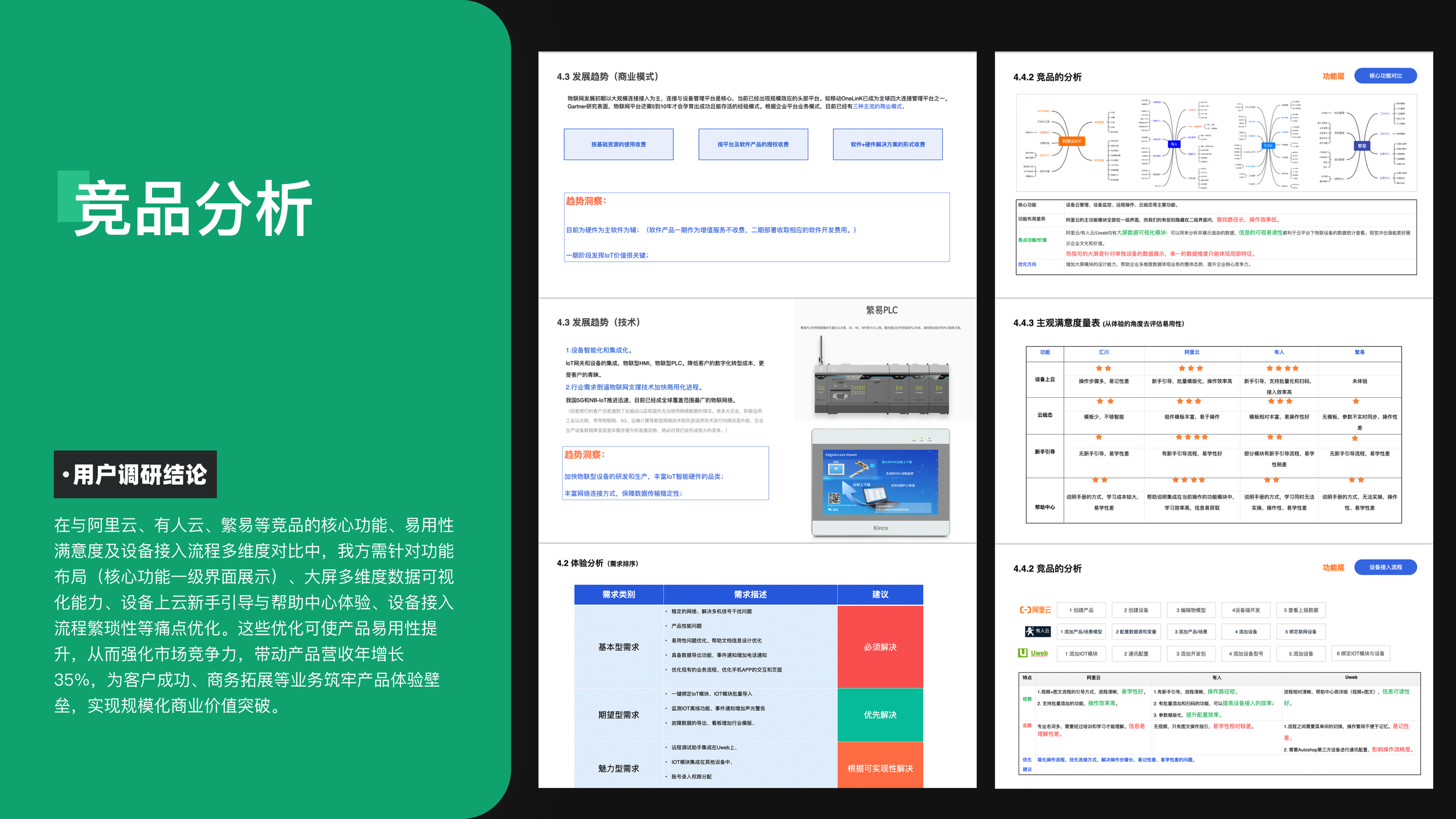
Benchmarking against platforms such as Alibaba Cloud revealed gaps in onboarding, feature focus, and data visualization. Targeted optimizations addressed these gaps, strengthening usability and value perception, and supporting an estimated 35% revenue growth potential through experience-driven differentiation.
体验目标与需求优先级梳理
客户体验目标制定
围绕专家、顾问与小白三类核心用户,设定清晰且可量化的体验目标:专家与小白用户目标评分为 4.5–4.6,顾问用户为 4.2。该目标体系明确了不同用户在功能稳定性、使用效率与易用性上的改进方向,为体验迭代提供统一衡量标准。KANO 需求分析
基于 KANO 模型对用户需求进行分层:11 项基础需求、7 项期望需求、3 项魅力需求。结合可用性问题分布,明确优化优先级,确保设计与研发资源聚焦于对满意度和业务价值影响最大的环节。竞品分析与差异化策略
对标阿里云等行业平台,识别其在新手引导、功能聚焦与数据可视化方面的不足,并据此制定针对性优化方向。通过提升易用性与价值感知,构建体验差异化,支撑约 35% 的营收增长潜力。
05|Experience Goals & Prioritization Framework
1. Reducing Adoption Risk through Error-Tolerant Experience Design
通过高容错体验设计降低客户使用风险
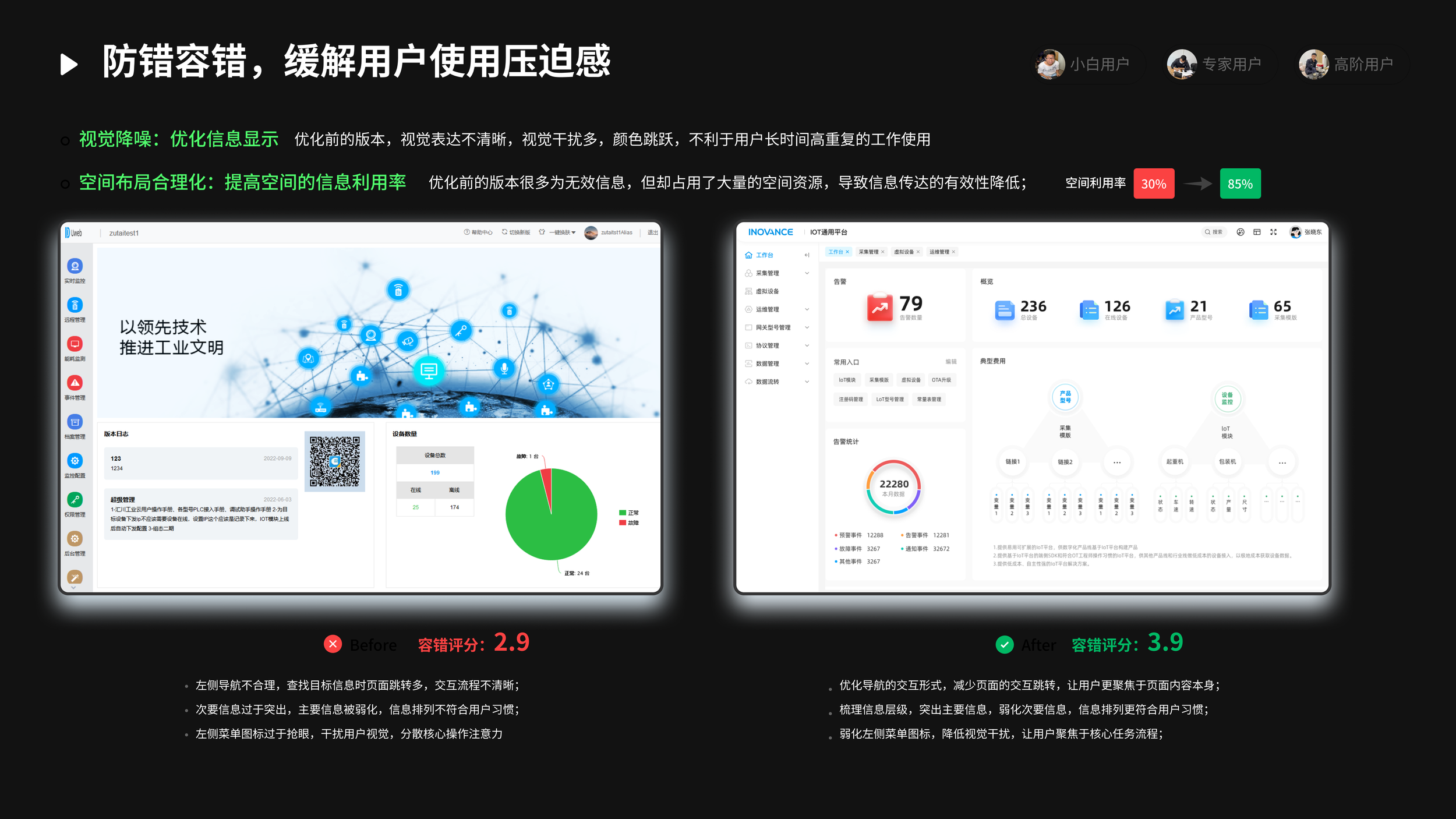
By reducing visual noise and restructuring information hierarchy, the solution significantly lowered cognitive load during critical operations. Screen space utilization increased from 30% to 85%, enabling users to focus on core tasks with fewer interruptions.
As a result, the error-tolerance score improved from 2.9 to 3.9, directly reducing operational mistakes and support dependency — a key success factor for enterprise-scale rollout.
通过视觉降噪与信息层级重构,显著降低关键操作场景下的认知负担,界面空间利用率由 30% 提升至 85%。容错评分从 2.9 提升至 3.9,有效减少操作失误与客户支持依赖,为大规模客户交付提供稳定基础。
2. Enabling Scalable Business Execution via Unified App Experience
以统一体验支撑可规模化的业务执行
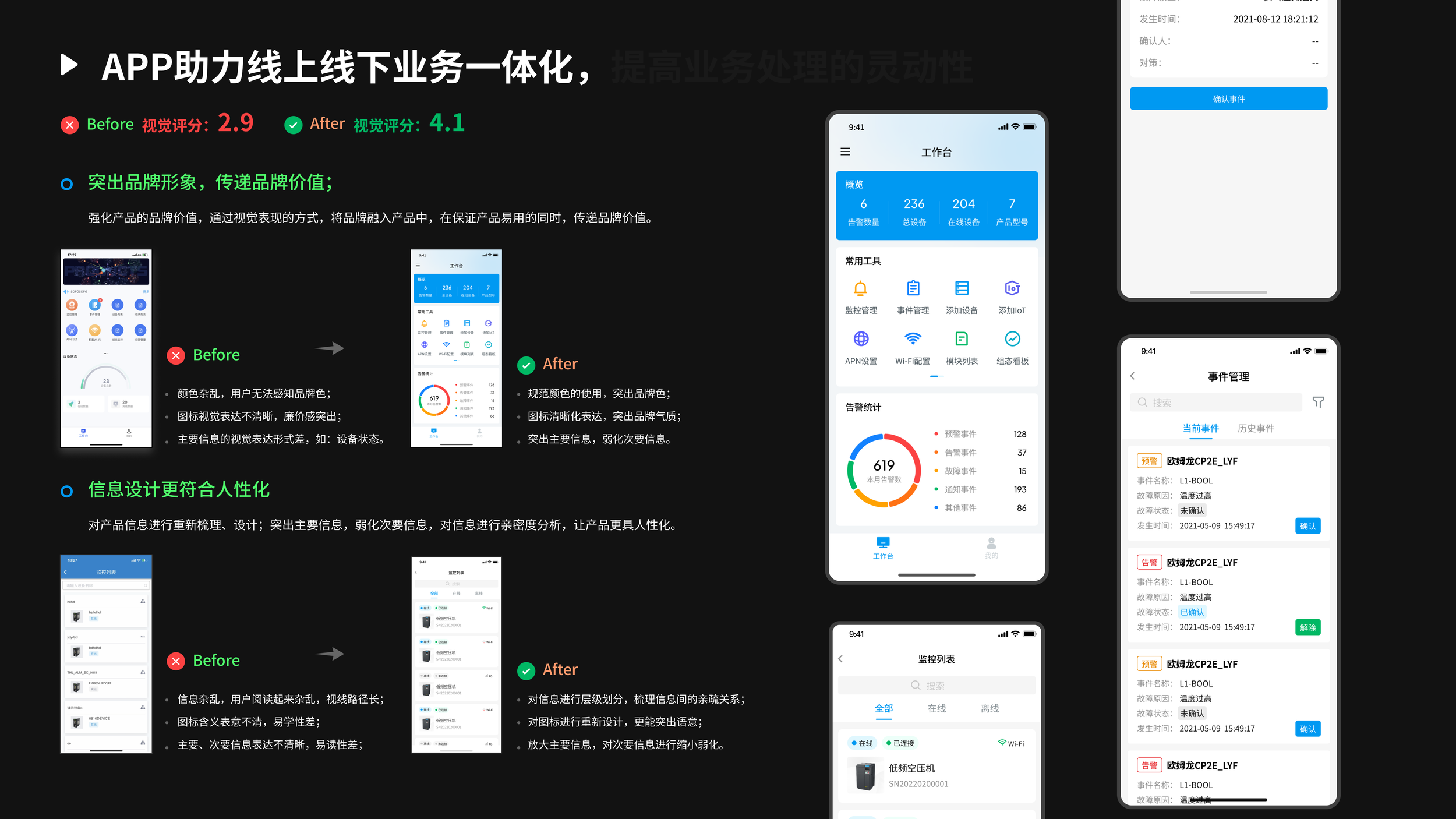
By aligning brand visuals and information architecture, the app experience was unified across service and business scenarios. Visual experience scores increased from 2.9 to 3.9, strengthening user trust and reducing learning friction.
This integration enabled smoother online–offline business execution, supporting repeatable service delivery and consistent customer experience across regions and teams.
通过统一品牌视觉与信息设计,应用体验在服务与业务场景中实现一致性,视觉评分由 2.9 提升至 3.9。该优化有效支撑线上线下一体化业务执行,为跨团队、跨区域的服务复制提供可靠体验基础。
3. Improving Learnability to Accelerate Customer Time-to-Value
提升易学性,加速客户价值达成(TTV)
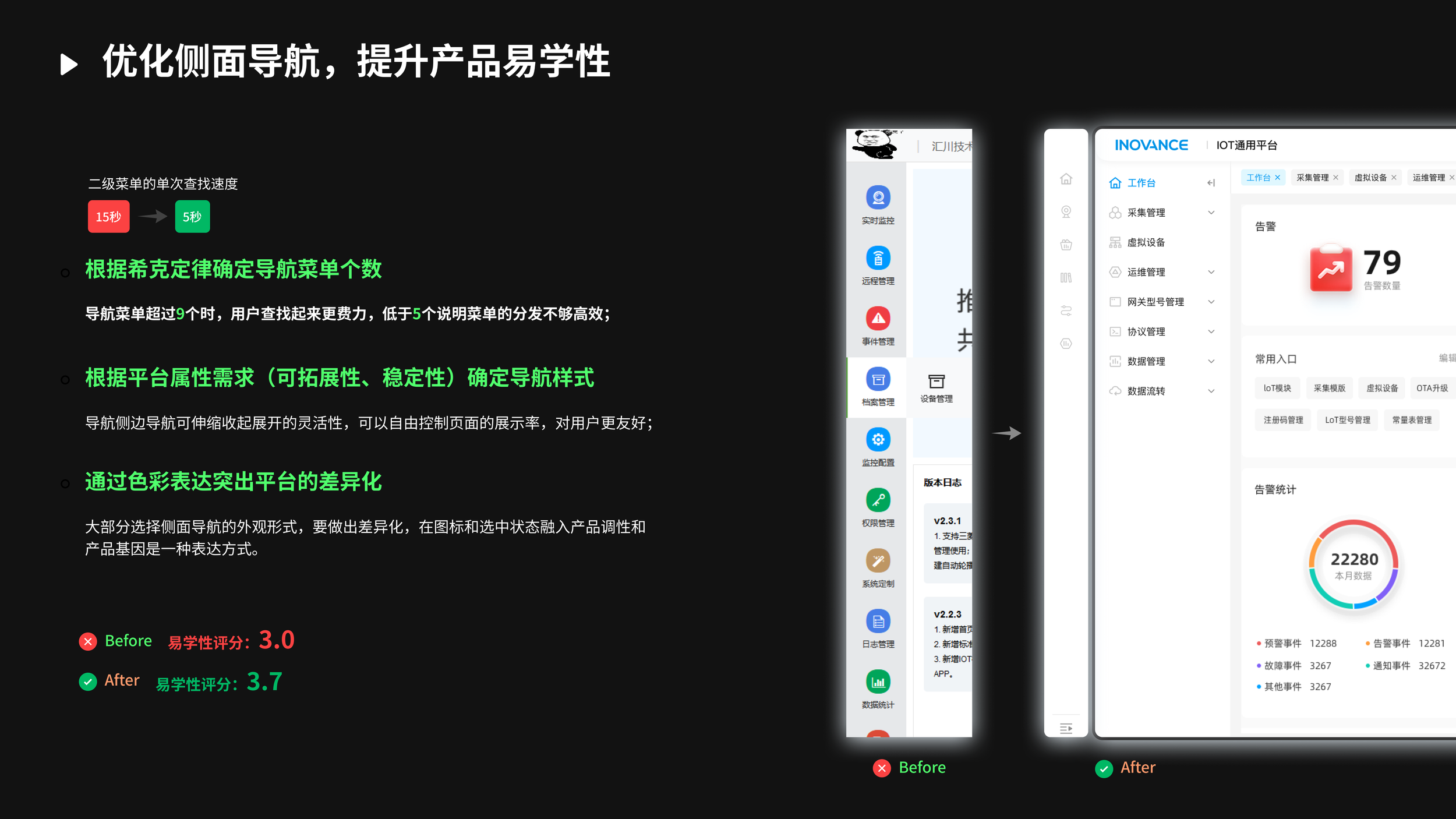
Navigation structures were optimized based on Hick’s Law to reduce decision complexity. Secondary menu search time was reduced from 15 seconds to 5 seconds, while learnability scores improved from 3.0 to 3.7.
This significantly shortened onboarding cycles and enabled customers to reach productive usage faster — a critical driver for adoption and renewal in enterprise SaaS.
基于希克定律优化导航结构,降低选择成本,二级菜单查找时间由 15 秒缩短至 5 秒,易学性评分从 3.0 提升至 3.7。该提升显著缩短客户上手周期,加速价值兑现,是推动客户采用与续约的关键因素。
4. Making Device Onboarding Repeatable and Delivery-Ready
让设备接入成为可复制、可交付的标准能力
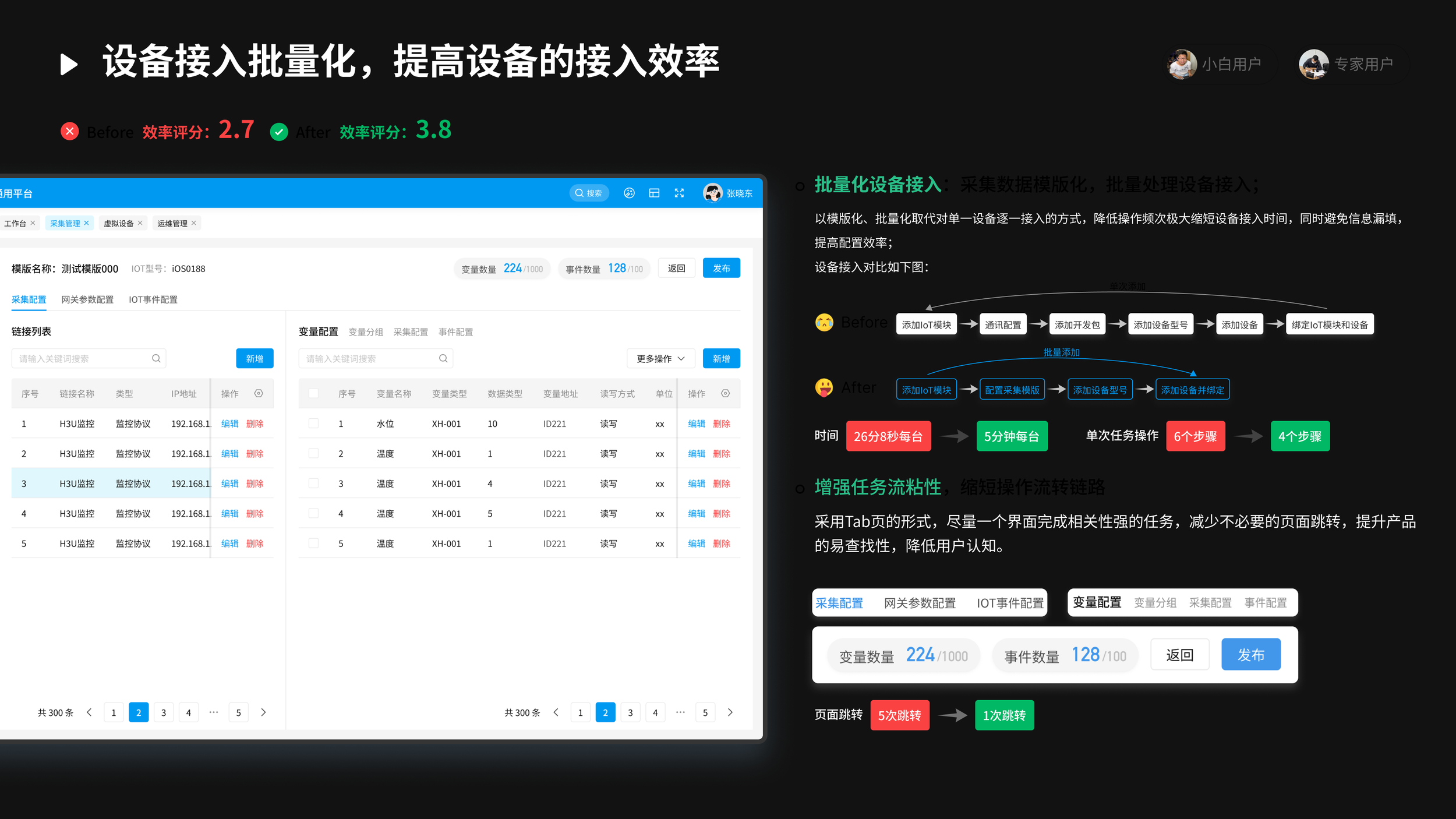
Through template-based and batch onboarding workflows, device access efficiency was dramatically improved.
Single-device onboarding time was reduced from 26 minutes to 5 minutes, operational steps from 6 to 4, and page transitions from 5 to 1.
Efficiency scores increased from 2.7 to 3.8, enabling partners and service teams to deploy at scale with predictable effort and cost.
通过模板化与批量化接入流程设计,大幅提升设备接入的可复制性:
单台设备接入时间由 26 分钟缩短至 5 分钟,操作步骤由 6 步降至 4 步,页面跳转由 5 次降至 1 次,效率评分从 2.7 提升至 3.8。该能力为渠道与服务团队提供了标准化、可规模交付的设备部署方案。
📈 06|Outcomes & Business Impact 成果与业务影响
Using a validation framework combining efficiency, task success rate, and satisfaction, the platform achieved measurable improvements:
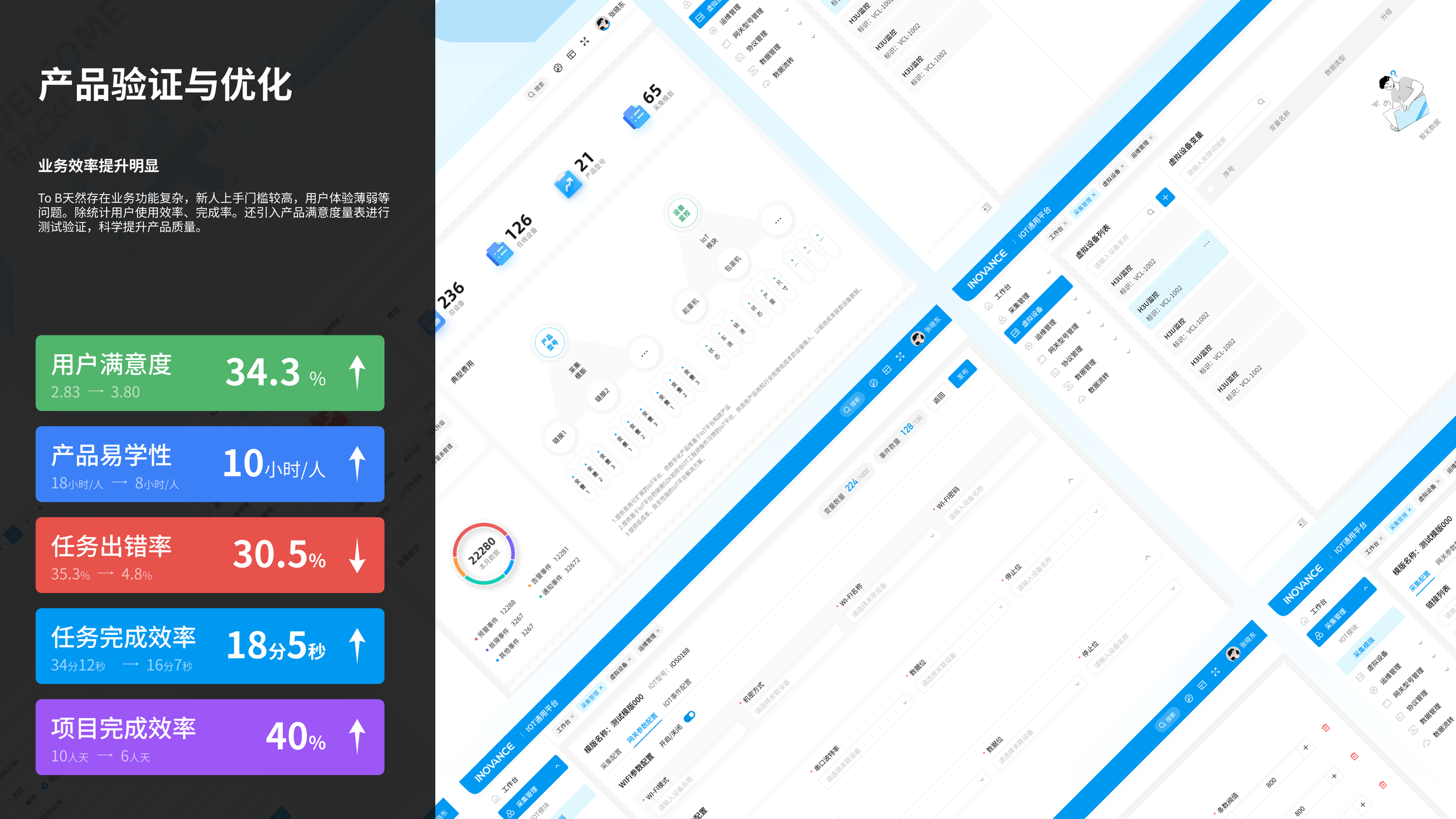
User satisfaction: 2.83 → 3.80 (+34.3%)
New user onboarding time: 18h → 8h per user (-56%)
Task error rate: 35.3% → 4.8%
Key task efficiency improved by nearly 50%
Delivery cycle reduced from 10 days to 6 days (+40%) 成果与业务影响|Outcomes & Business Impact
基于“使用效率 + 完成率 + 满意度”的量化验证体系,平台关键体验与业务指标获得显著提升:
用户满意度:2.83 → 3.80(+34.3%)
新用户上手时间:18h → 8h / 人(-56%)
任务出错率:35.3% → 4.8%
关键任务完成效率提升近 50%
项目交付周期:10 天 → 6 天(+40%)
The results validated SLM’s ability to maintain high compatibility and low expansion costs while significantly improving user efficiency and commercial viability, laying a solid foundation for scalable industrial IoT and service-led growth.
项目验证了 SLM 平台在保持 高兼容性与低扩展成本 的同时,显著提升了用户效率与商业可行性,为工业物联网平台的规模化推广与服务化转型奠定了基础。